
Other then being the end of the line as far as a navigable Duoro is concerned, Barca d’Alva doesn’t have much to recommend it. What it does have to offer is its location, being less than 1 km from the Spanish border.
So today, we exchanged the melancholy of fado for the exuberance of flamenco, leaving Portugal and traveling to the golden city of Salamanca, Spain. It was about a two hour bus ride (with one comfort stop) before we saw the walls, buildings, domes and steeples of our destination, much of it built with a yellowish sandstone that earned this city its “golden” moniker.
We’re dropped off on the edge of the old town where we meet our local tour guide and begin our trek into the historic center of Salamanca.
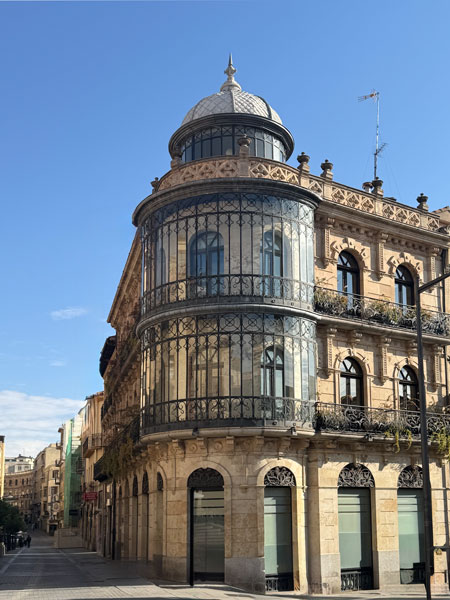
Seen as we entered town
Salamanca Plaza Mayor
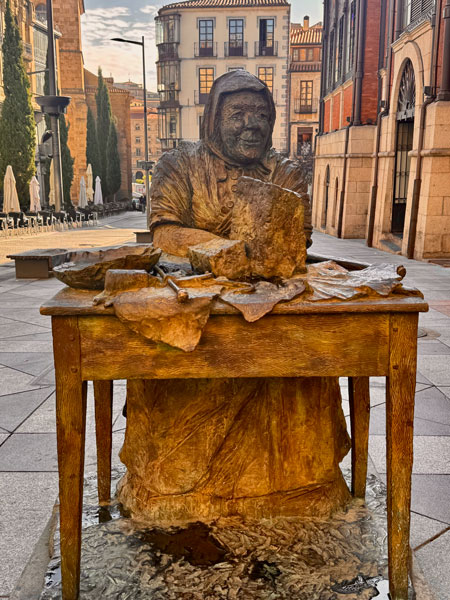
Leaving the rusting nougat-maker statue behind us, we are led into the Plaza Mayor‘s central courtyard, considered to be the heart of the old city and one of Spain’s most beautiful public squares. Built in traditional Spanish Baroque style, an arched arcade rings the entire square and features shops, restaurants, bakeries, etc. along its shaded gallery. The balconied upper floors are mostly private residences. And among the many architectural details, there are circular medallions featuring famous Spaniards set between each pair of ground floor arches.
Timing is everything, however, and when we entered the square, most of the western half was barricaded and off-limits. Behind the plywood barrier, rows of booths were being set up for a booksellers’ event that weekend. But, as we still had half-a-plaza available, the impact of this public space was not completely lost in the chaos. We just had to put our backs to the wall and face east!
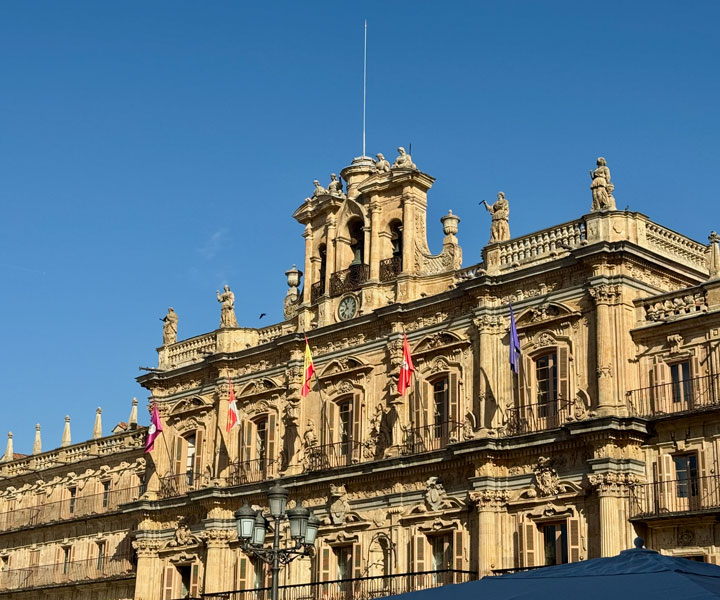
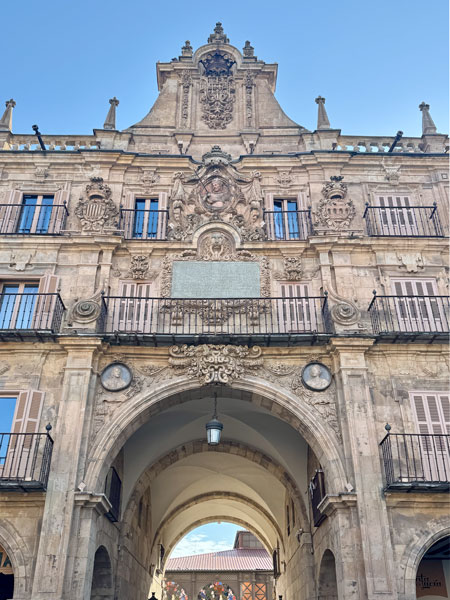
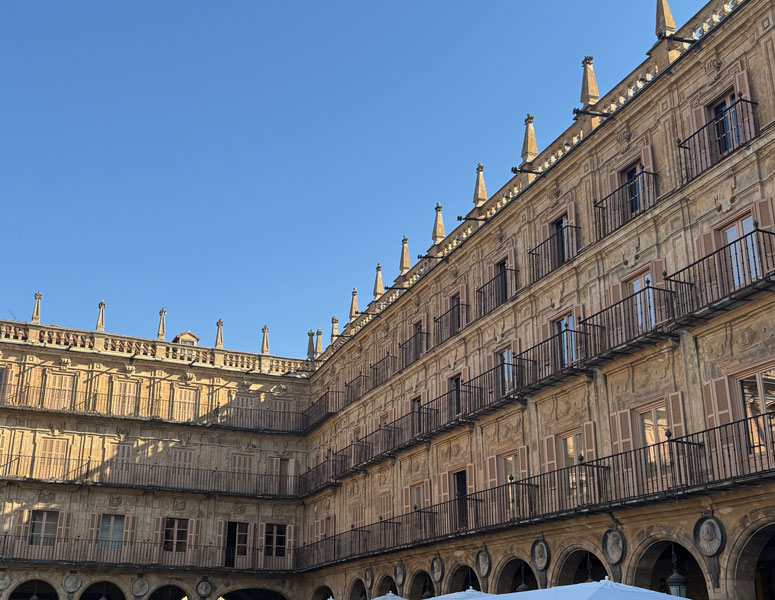
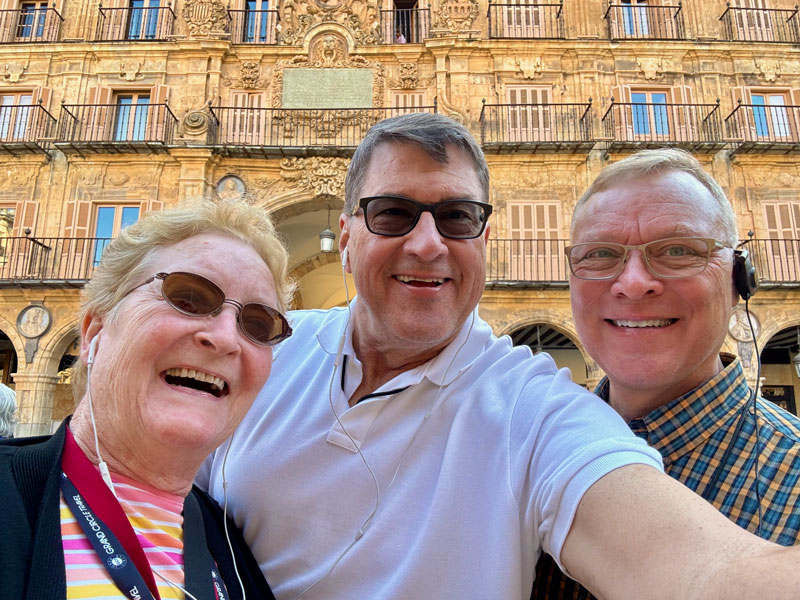
After establishing the plaza to be our meeting point at the end of the day, we exited the square through one of its six arches, following our yellow flag back onto the streets of Salamanca.
Learning about Iberian ham
As we entered one of the shopping areas around the Plaza Mayor, our tour guide pulled us aside to a small butcher shop for a quick introduction to a local specialty: jamón ibérico. The origin and quality of Iberian jamón (ham) is delineated by a four-color code that determines its quality. Our guide explained this color-coded system before we were given samples of jamón to taste.
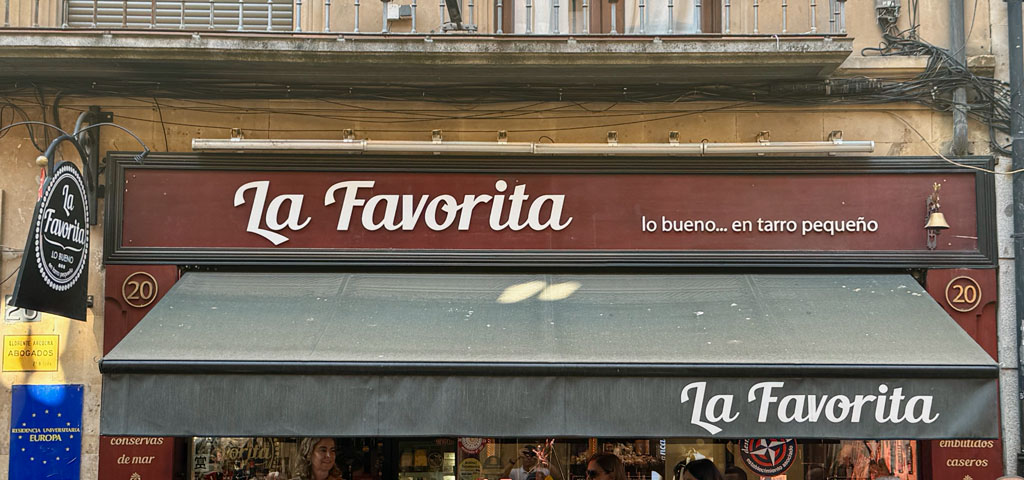
In brief: jamón with a black label indicates it was sourced from a mostly acorn-fed, 100% Iberian pig breed and is considered to be The Best. Red, green and white labels indicate a breed that is only 50% or 75% Iberian. Their diets, in descending quality order, consist of acorns & pasture (red), pasture & feed (green) or feed only (white).
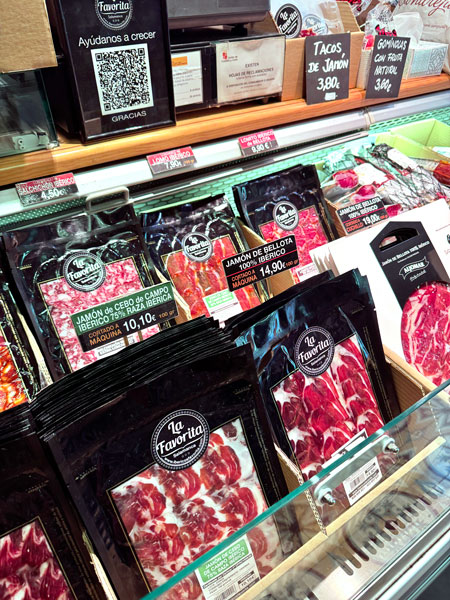
You are what you eat…and that obviously applies to slaughtered swine.
Probably because, as tourists, we really couldn’t appreciate the nuances between hams, we sampled green. It was delish…but what do I know!
Still savoring the lingering umami of our porcine sampler, we continued down the shop-lined street towards an imposing domed bell tower.
Two…two…two churches in one
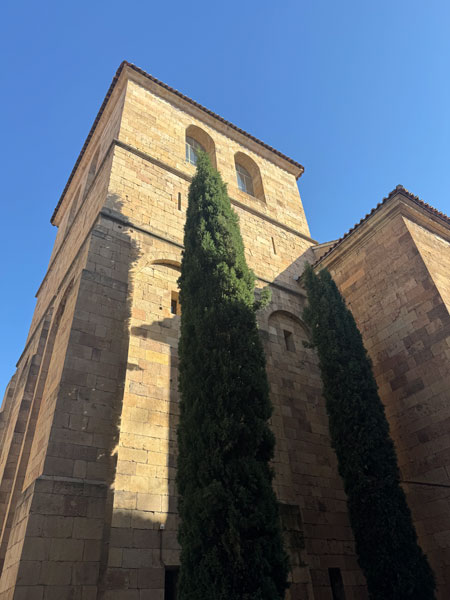
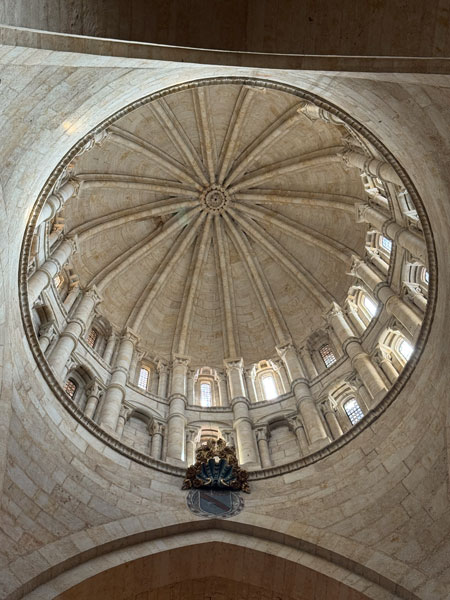
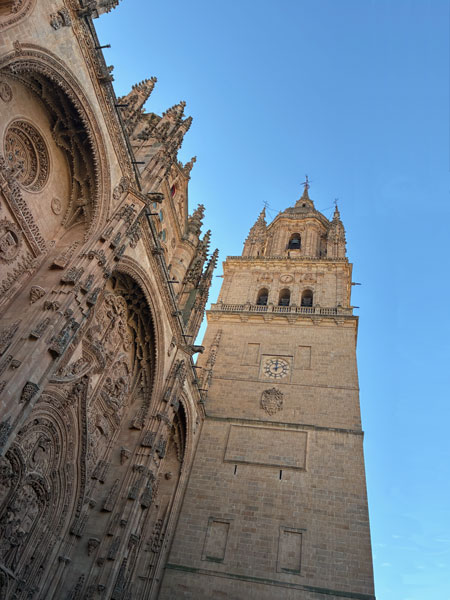
Salamanca is somewhat unique in that it has two recognized cathedrals, generally referred to as the Old and the New, that share a common wall along with the aforementioned bell tower.
In brief: back in the olden days, because of its popular university, the city’s diocese decided that the original (or “old”) cathedral was inadequate for the burgeoning town. Appeals were made to higher ups, and Salamanca was granted permission to build a new cathedral to serve their growing congregation.
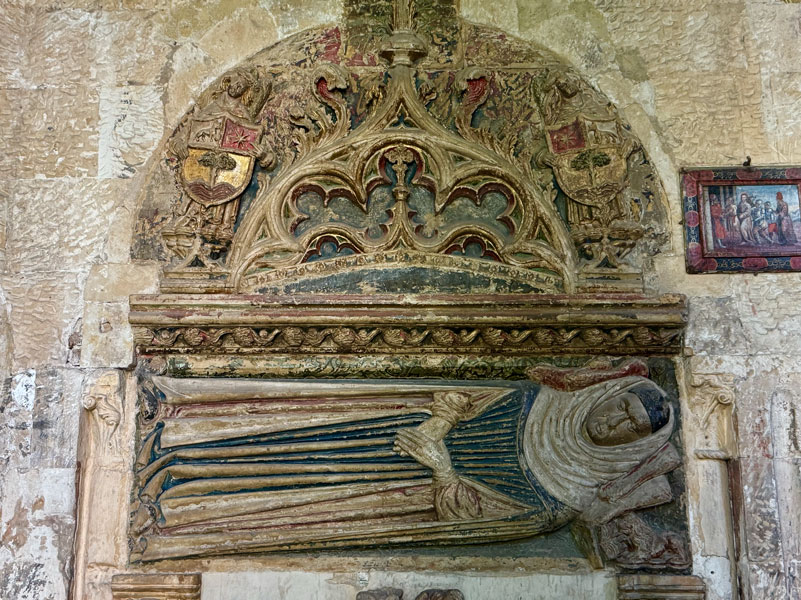
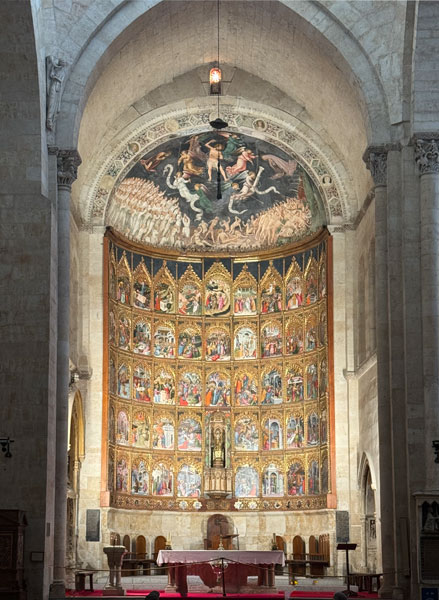
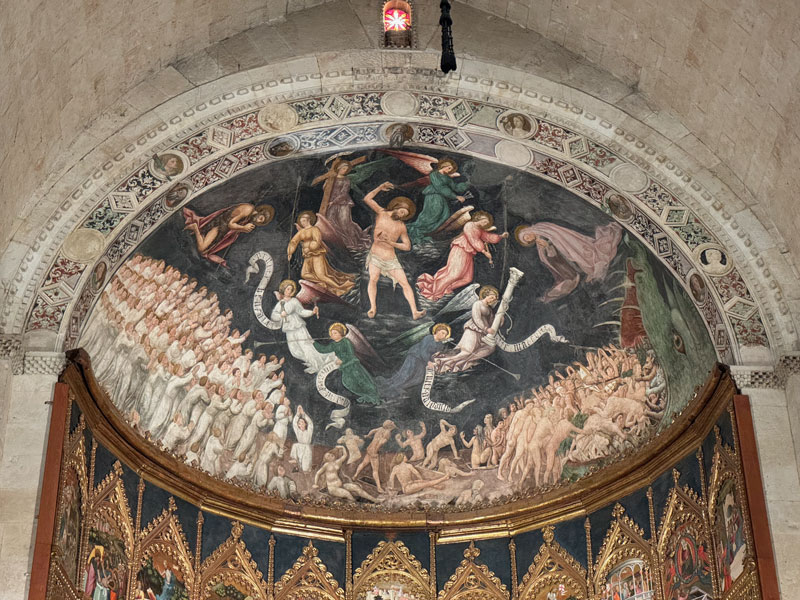
Original plans for the old church were to continue using it until construction was completed on the new…and then demolish it. However, minds change. The new building became the principal diocesan church and home to the bishop’s chair (the cathedra) and the old cathedral remained, becoming the default church for university students. It is still in use today although on a much more limited basis.
The Old Cathedral (née Cathedral of Santa María)
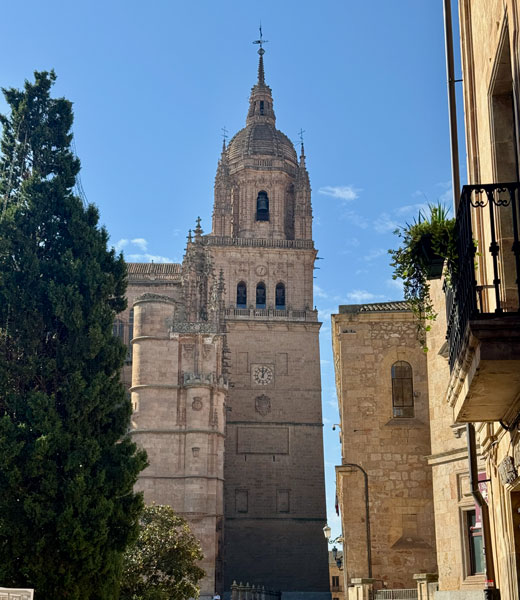
The New Cathedral (née Cathedral of the Assumption of the Virgin Mary)
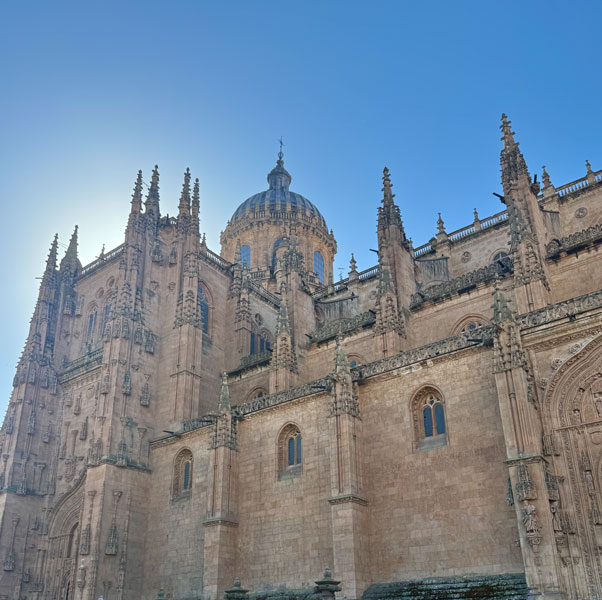
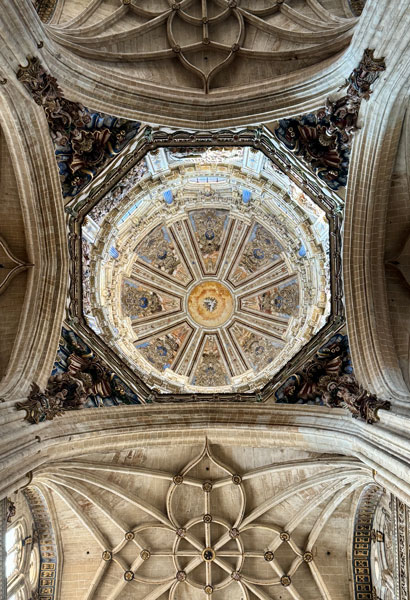
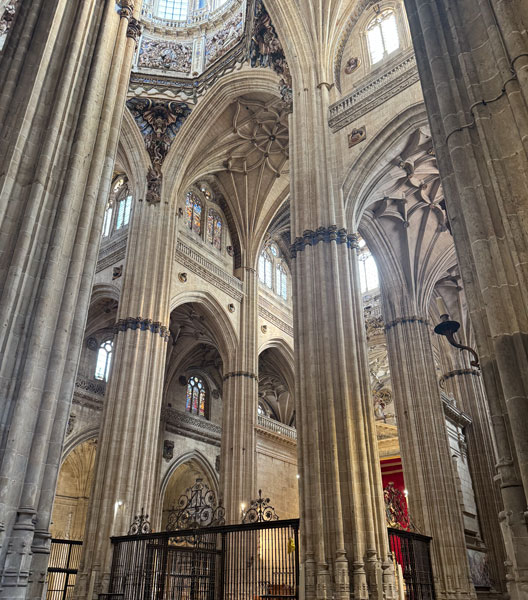
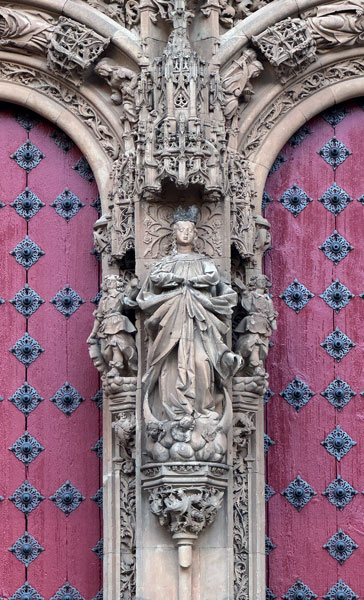
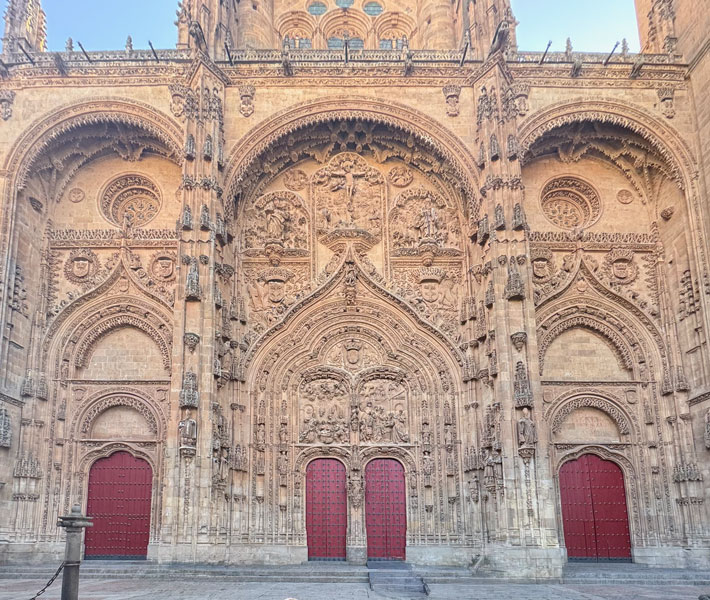
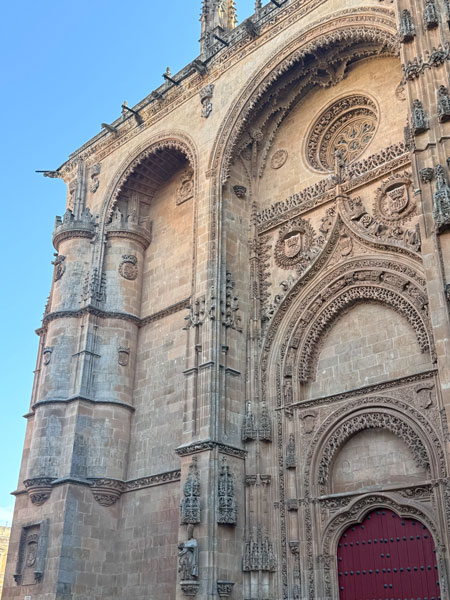
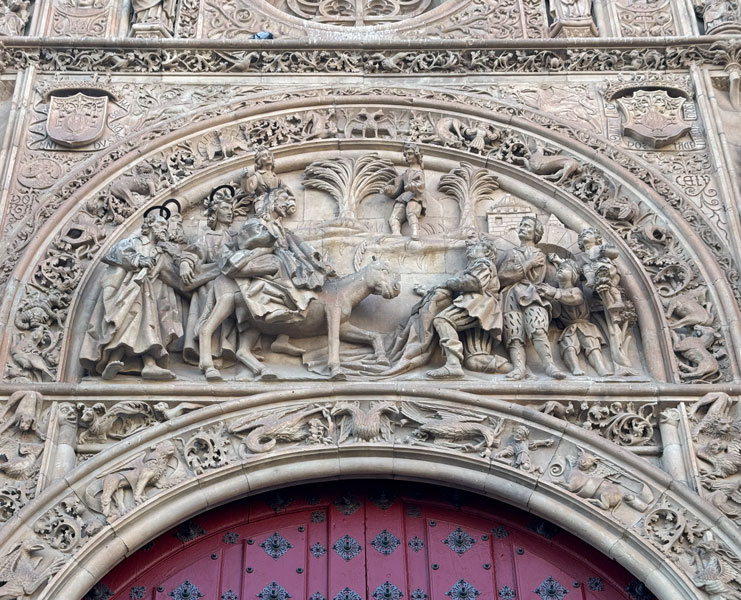
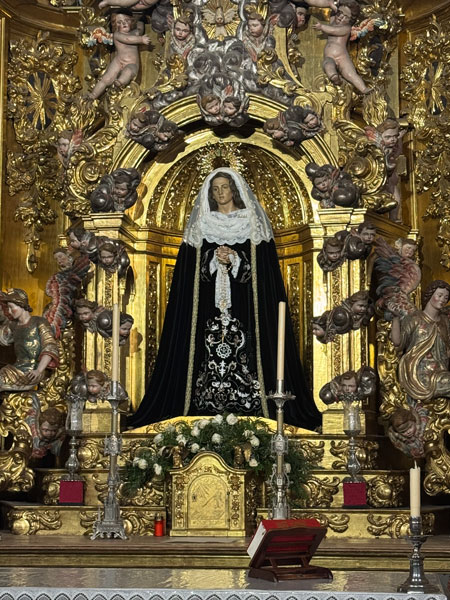
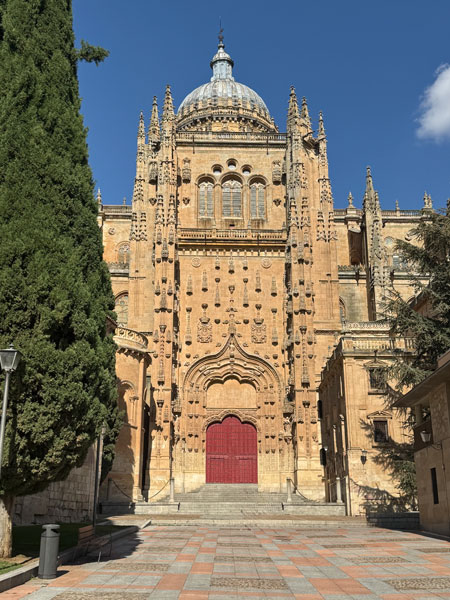
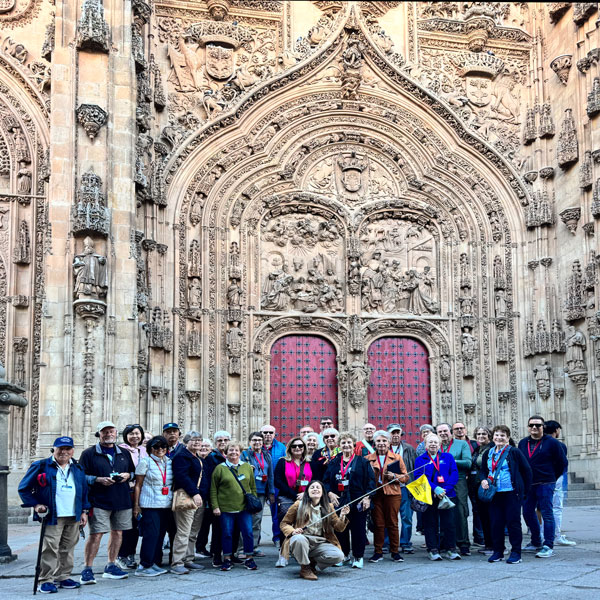
I don’t have as lot to say about the new cathedral. It is a beautiful building, both inside and out. Soaring columns and gothic arches will always get my heart pounding. The sculptural western facade is breathtaking as well. Unfortunately, it faces other buildings on a somewhat narrow street so it has to be digested in small bites rather than as a full-on feast for the eyes. I’ve included a few “bites” in my photos.
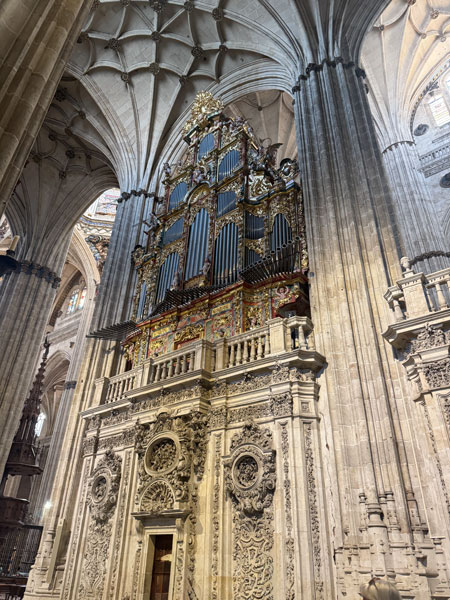
• Fun fact: there are multiple organs between the two churches. The New cathedral has two grand organs facing each other in the raised (closer to heaven) choir. Can’t miss ’em.
But, in the Old cathedral, our tour guide pointed out two time-worn, easy-to-ignore wooden “cabinets”, one on each side of the sacristy. She said these were the original organs from the church and that both, altho’ no longer played, were still in working order.
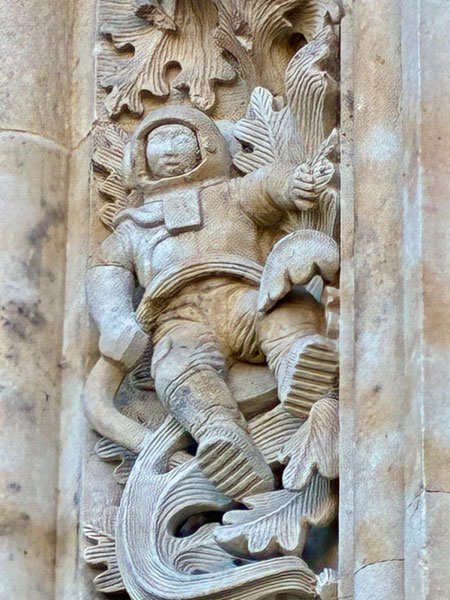
• Another interesting oddity was pointed out to us on the north facade. Some of the stonework has had to be replaced due to erosion over time. The sculptor creating these particular replacement inserts added a modern twist to his work by incorporating, among several non-period subjects, an astronaut, bringing the cathedral into the 20th century.
Universidad de Salamanca
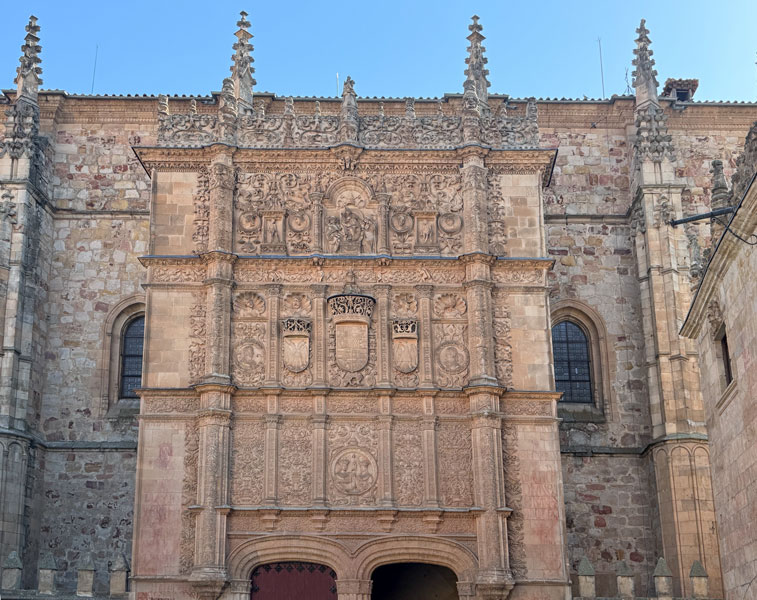
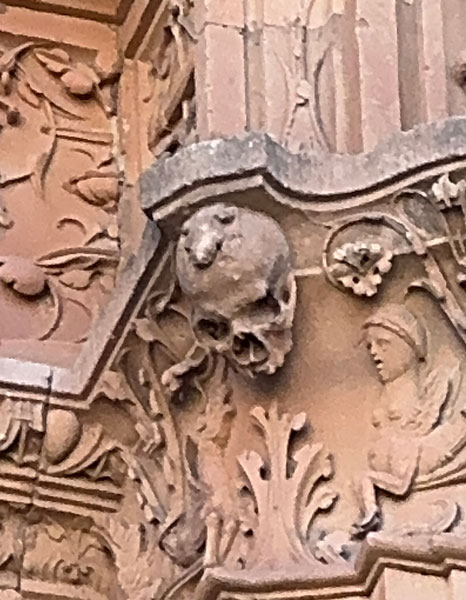
The “Oxford of Spain” was founded in 1218 by King Alfonso IX. It is the oldest university in the Hispanic world and the fourth oldest in the world in continuous operation. The main building’s intricately-carved facade is the foundation of one of the school’s more curious legends. There is a small frog carved on top of a human skull. Legend has it that finding the frog brings good luck…or, more importantly for students, guarantees they’ll pass their exams. Cartoons of this image populate souvenir shops throughout the city.
Ex-Jesuit university and church
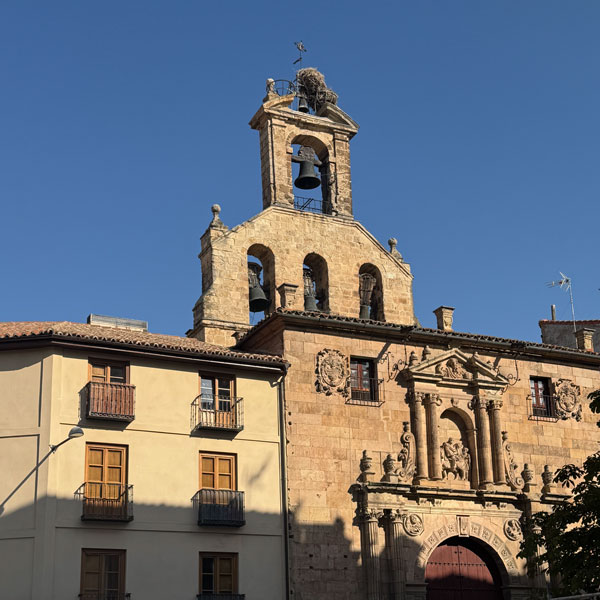
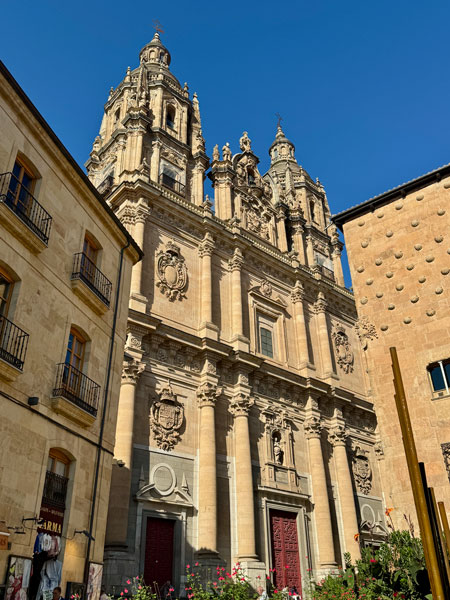
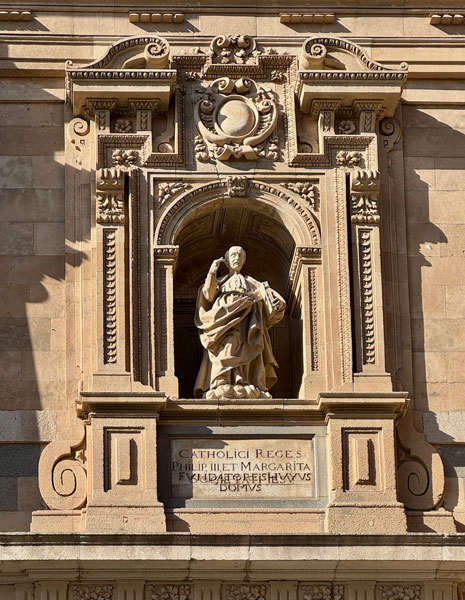
Before the Black Robes got thrown out of Spain, they had established the Real Colegio del Espíritu Santo (Royal College of the Holy Spirit) with the attached Santo Espíritu church. (That’s a likeness of Ignatius Loyola perched above the central door.)
After the Jesuit expulsion in 1767 (and just 13 years after the completion of the baroque church), the facilities were turned over to another order. It was rechristened La Clerecia after its new overlords, its name to this day. The former Jesuit school is now the private Pontifical University of Salamanca.
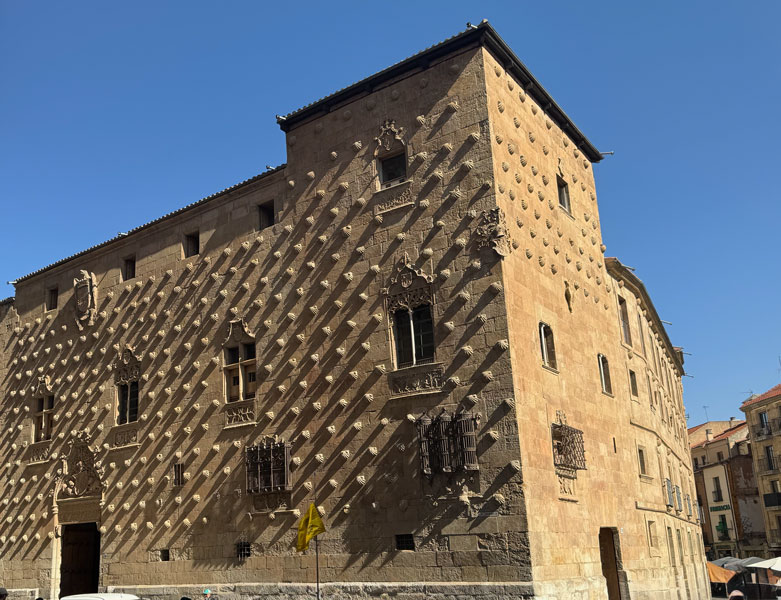
Across the street from this former Jesuit enclave is the Shell House, so nicknamed because of the seashell appliques that cover its exterior walls. And next door to this curious building is the restaurant where we had lunch. (Sorry, no foodie pics…although I remember the wine being quite good.) Once lunch was a fait accompli, we were set free to wander las calles on our own.
We started in a souvenir shop (or “crap” store, as Peg likes to call them)…where Nancy’s interest waned and she wandered off. After purchases were transacted, we set off with two goals: Peg needed a comfort stop & I wanted to see the Roman bridge. With afternoon siestas at play, available public loos were in short supply. So, the bridge came first.
Roman Bridge, a Pre-Roman beast and I
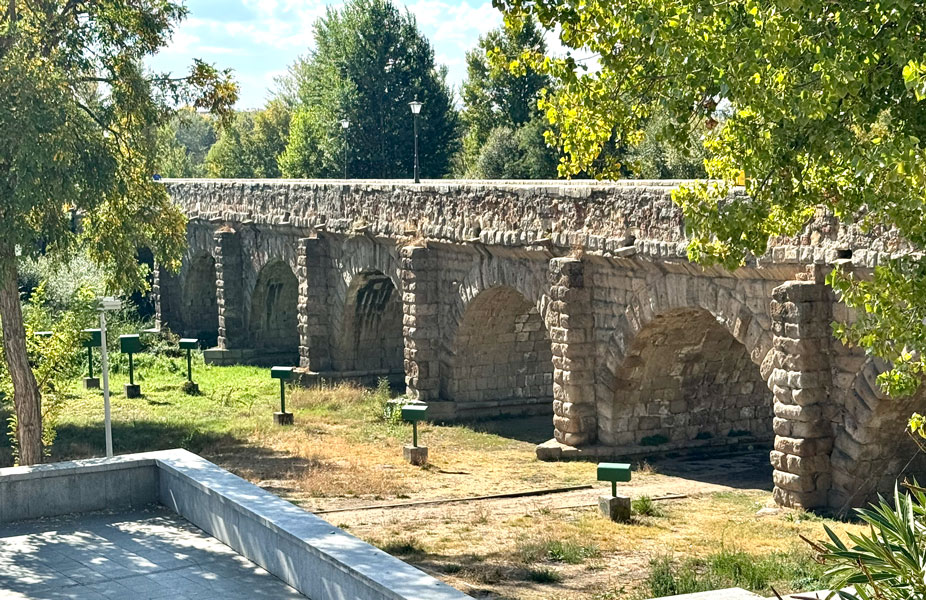
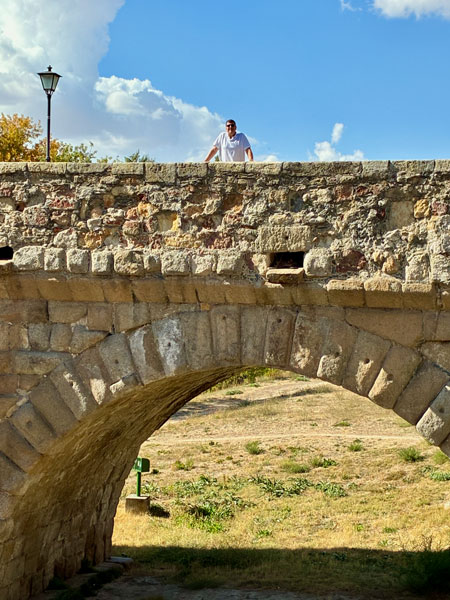
Salamanca was a strategic post along a primary Roman trade route (the Via de la Plata or Silver Route) from north to south. The most important existent “ruin” from those times is the Tormes River bridge, built to give access to the opposite bank and points south. I, of course, wanted to get up close and personal with said structure. So, leaving Peg to rest on a bench overlooking the Tormes River flood zone, Rob and I checked out this still rock-solid Roman relic.
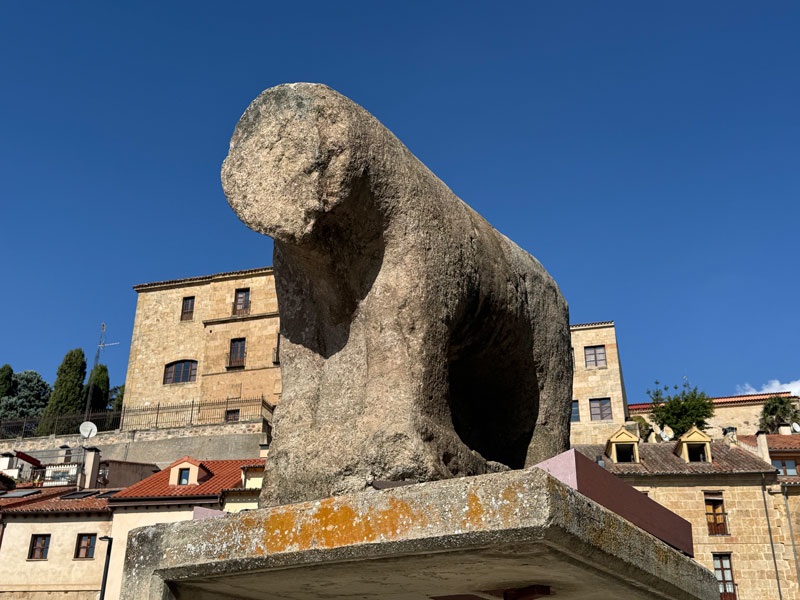
At the northern end of the bridge is a pre-Roman verraco (stone animal sculpture) from the Iron Age that depicts a bull. How they landed on it being a bull is a mystery. But it is really old.
Adios, Salamanca
With time running out, we circled back around the paired cathedrals on our way to rejoin our fellow “yellows.”
But we had one task left.
Using her prodigious PBS skills, Peg was able to talk her way back through the cathedral’s gift shop to the church’s restrooms. Whew!
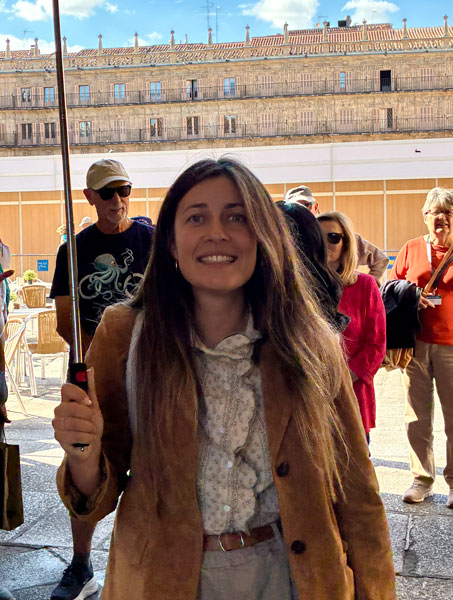
Our group congregated back in the Plaza Mayor to return to the bus and, eventually, the boat. As usual, Joana was there brandishing her yellow flag (cropped from the picture) and counting heads.
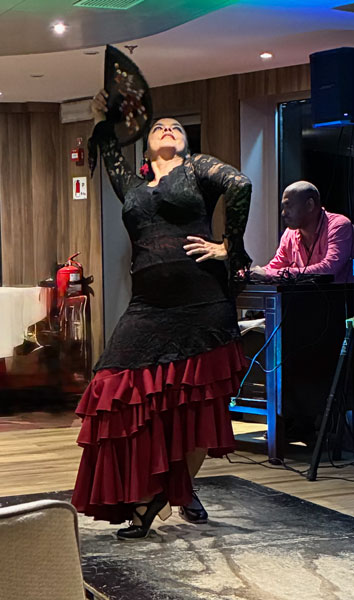
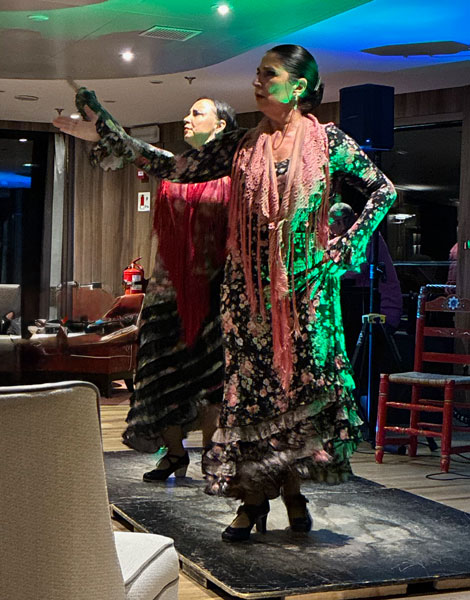
Flamenco Dancing
This evening’s entertainment tied in nicely to our day in Spain: flamenco dancers. Rob attended…but was nodding off and left mid-performance. Having been to a flamenco school in Seville last year, I skipped it entirely.
Happy milestone Birthday, Ron – 65 years young!
 Portugal: Lisbão to Oporto