
Today, while our ship left Gaia for an upriver rendezvous location, we visited the city of Guimarães, recognized as Portugal’s birthplace. Here, the nation was founded (in 1128) and Portugal’s first king, Dom Afonso I the Conquerer, was born (sometime between 1109-1111. They were a bit lax when it came to recording birthdates back then.)
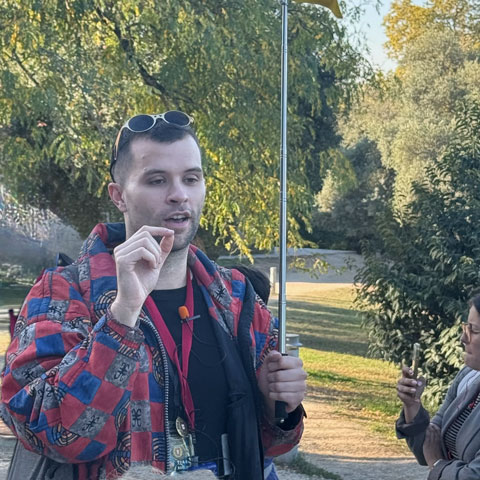
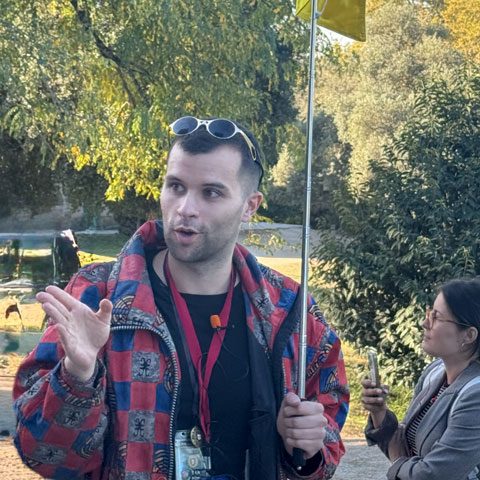
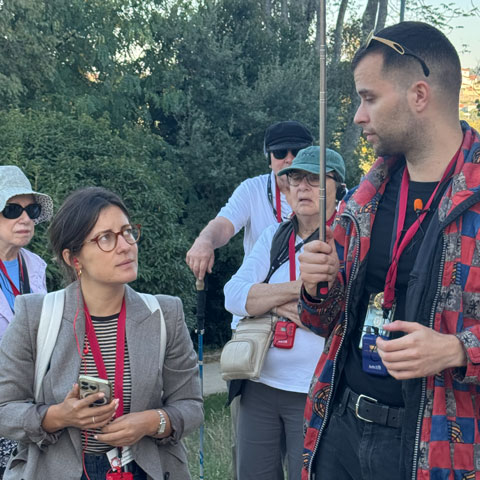
That was just one of the numerous fun facts about Guimarães and Portugal’s past we gleaned from our local guide, Tiago. A font of local knowledge, he delivered it with a wry sense of humor that kept the mundane amusing.

With a quaint and compact old town containing visual surprises at every turn, Guimarães’ focal point and tourist magnet is its historic castle hilltop. But the seemingly well-kept, neatly-landscaped setting comes with its own set of incongruities.
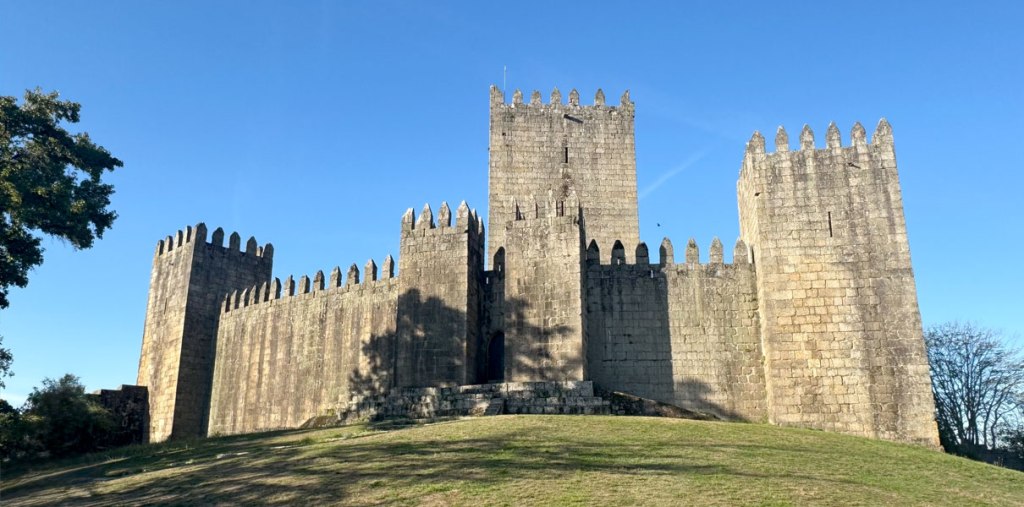

While a generation of Americans has a nodding acquaintance with the Spanish dictator Francisco Franco (or, more precisely, his death, thanks to a 1975 SNL gag-turn-catchphrase), fewer are aware of the “other” Iberian Iron Fist, the Portuguese dictator António de Oliveira Salazar, who founded and led the “New State” from 1932-1974. Like many dictators who try to legitimize their reign with contrived ties to the historic past, Salazar was instrumental in the restoration and/or creation of the castle hill trifecta, the Guimarães castle, the São Miguel do Castelo Church and the Bragança Palace as well as the demolition of any other adjacent buildings that did not fit the narrative.
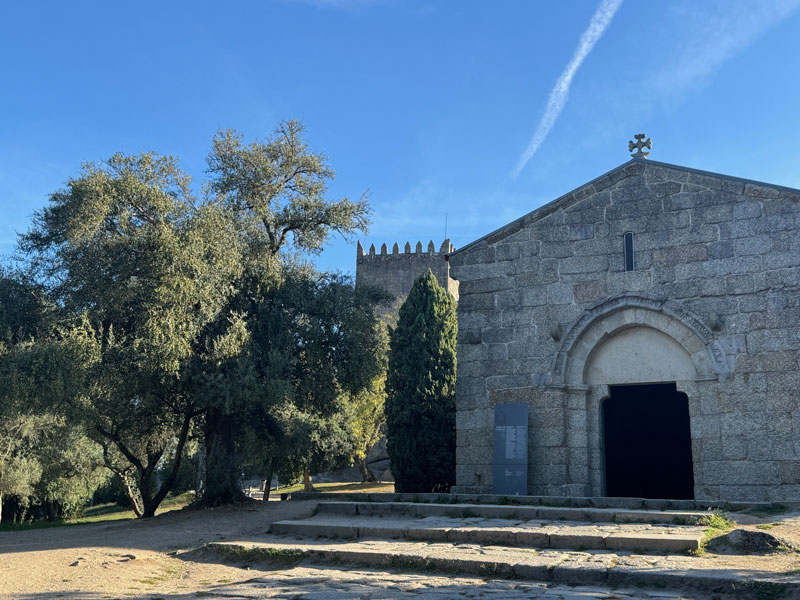
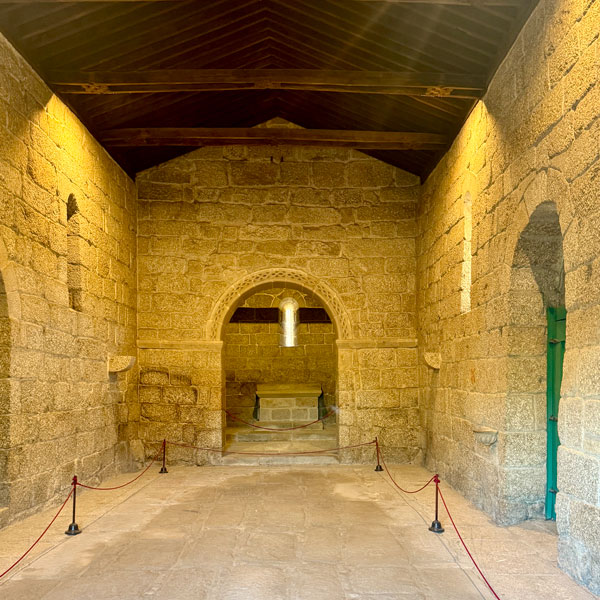
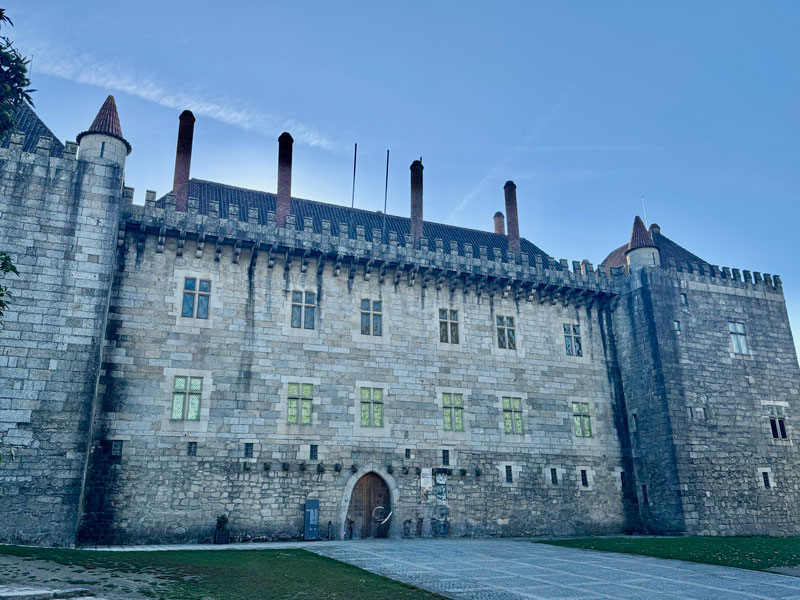
In the end, the resultant park-like setting is a lovely prelude to the charming town below…but built on some lies! For example, Alfonso I is purported to have been baptized in the small Romanesque chapel–a somewhat difficult feat since he was born in the early 1100s and the first chapel on the grounds was constructed in the 1300s. And today’s ducal palace is mostly a fairly-faithful reconstruction of the original. However, if you look closely at the stone facade, you can see the clear demarcation between original, naturally-shaped stones and larger, rectangular blocks that indicate how little of the original building remained before restoration.
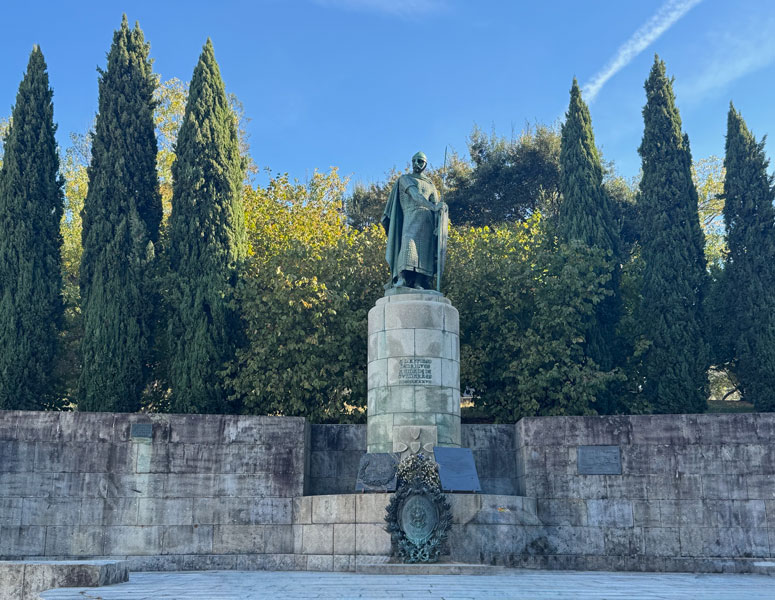
Leaving the hilltop behind us, we are introduced to a sculptural manifestation of the man himself, D. Afonso Henriques, also known as King Alfonso I, before beginning our descent into the old town center.
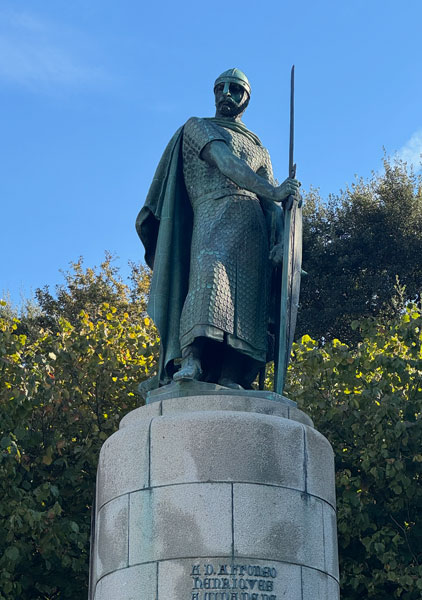
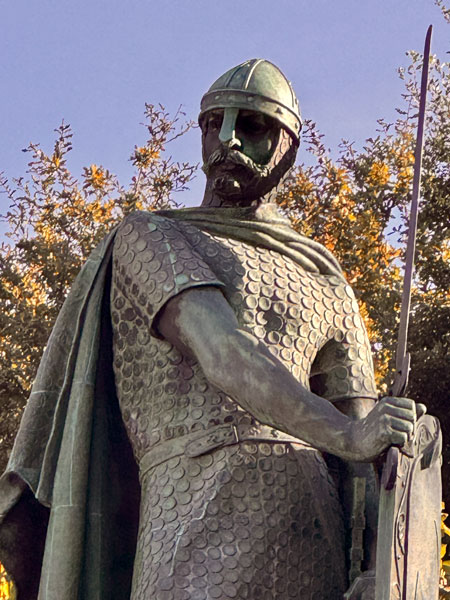
What follows are some of the architectural highlights and details that made our walk through Guimarães such a pleasure. Plus, there are a few stories to be told. But, just before leaving Alfonso and castle hill behind, there’s a measure of the trip that needs be marked.
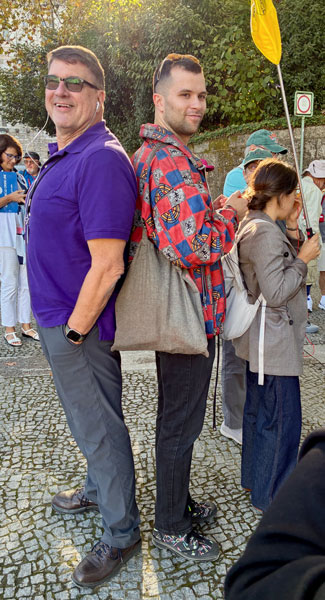
When giants meet
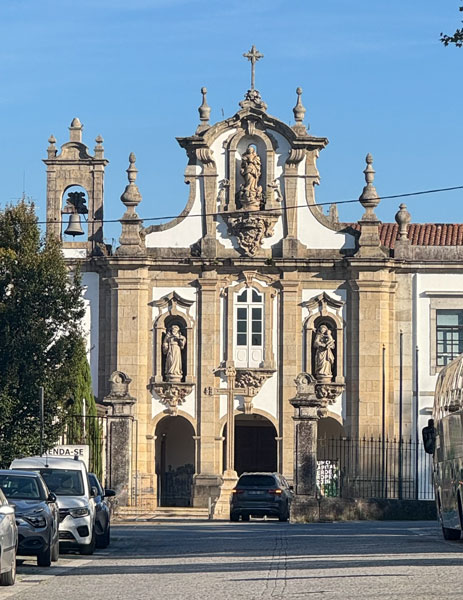
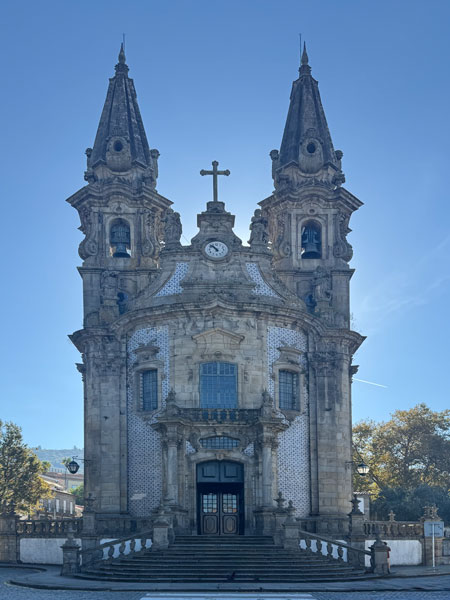
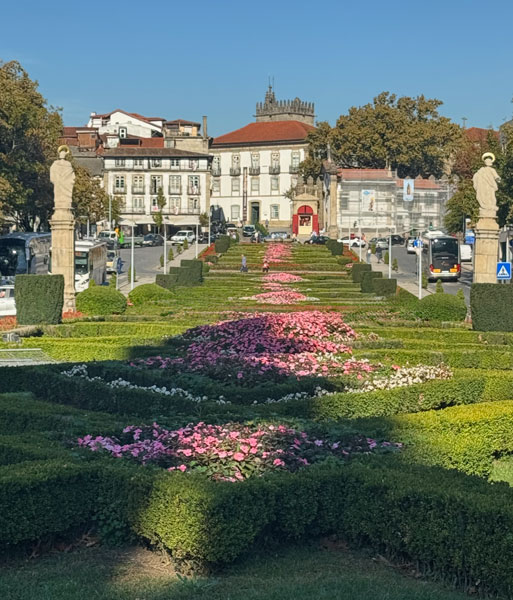
Architectural highlights of Guimarães
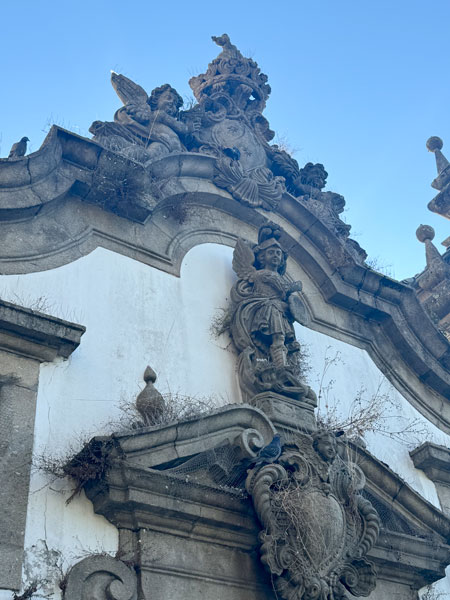
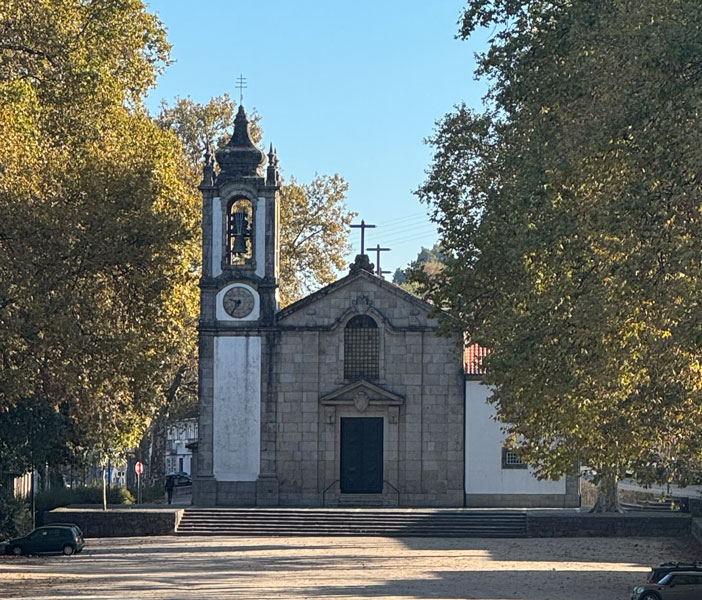
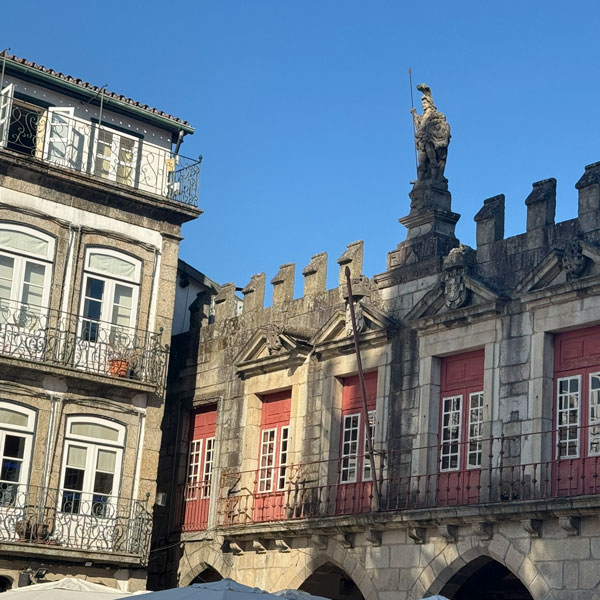
O Fogo! O Fogo! (Fire! Fire!)
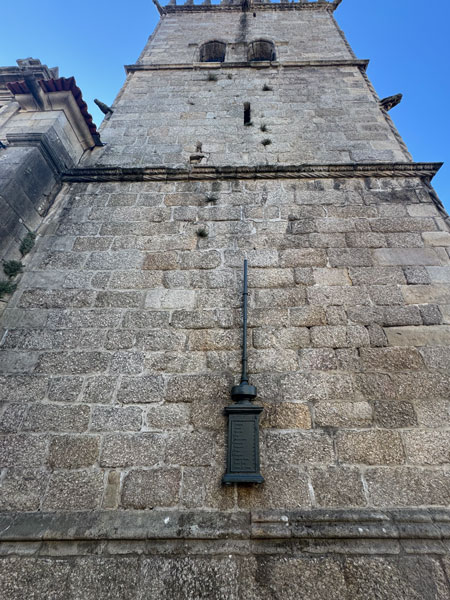
This is an example of a medieval fire alarm. The small black rectangular box is a numbered list of each church in the town. The tube extending from the top contained ropes attached to the church bells above.
In the case of fire, the alarmist went to nearest church alarm box, found its number, and started ringing the church bells that number of times to indicate the location of the fire. Other churches spread the alert by ringing the bells the same number of times as the original alarm. This continued until the fire was dealt with. Fascinating!
Convento de Santa Clara (Shame! Shame!)
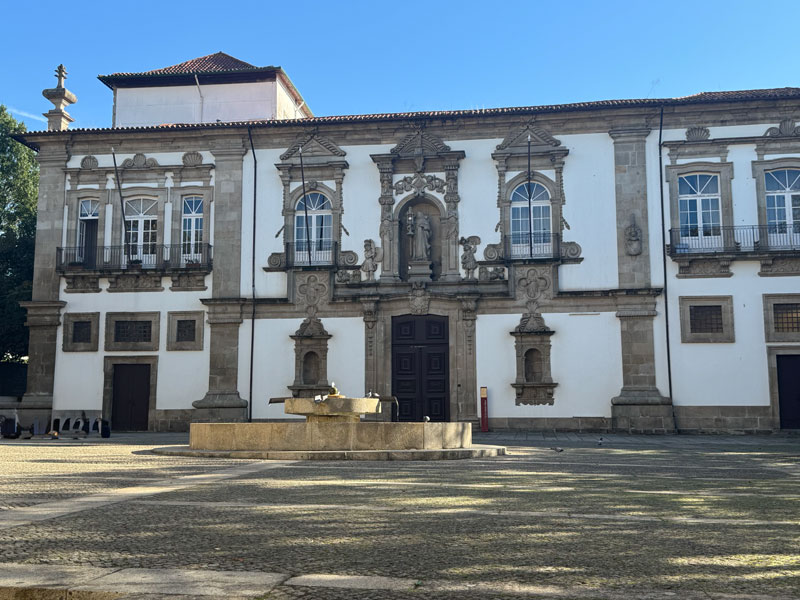
The “scandalous” cloister pictured above leads me to some interesting and even sacrilegious tidbits with a religious bent.
When the Portuguese monasteries and convents were dissolved in 1834, the property was seized and converted to public use.
But not immediately.
The men were out. Scram! Vamos! Tschau!
However, at the convents, it was “…until death do they part.” The properties remained under the religious order’s control until the last nun within died. In fact, while walking down from the castle, we passed a former convent that, once the last sister gave up her ghost, the building became an orphanage for girls…as it still is today.
Regarding the Convento de Santa Clara, apparently the cloistered institution had its share of scandals. Many involved an ornery bishop who seemed hell-bent on making life even more difficult (or more holy, depending on your viewpoint) for the cloistered (read: imprisoned) brides of Christ.
When said bishop discovered that family members were able to actually see and talk with their mothers/sisters/daughters through two special windows in a secluded area of the adjacent church, he shut it down…only to have the outraged nuns grab all the kitchen knives and exit the convent intent on exacting revenge. The patriarchy won.
The nuns were also revered in the town for their exquisite Torta de Guimarães, a local pastry delicacy. The bishop, however, felt that the cloistresses should be praying more and baking less. He forbade them to continue their culinary production…until a deal was broached and the operation was moved to an adjacent building.
Finally, there were rumors of randy prelates making nocturnal visits to the cloister to satisfy their prurient urges. (Of course!) But I leave those tales to your own imagination, MDR.
One of the many Ways of St. James
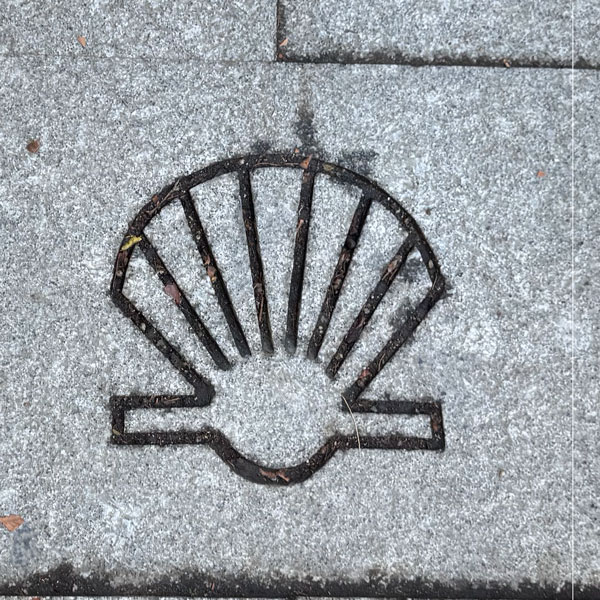
It is worth noting that Guimarães is on one of the El Camino de Santiago pilgrimage routes to Santiago de Compostela, Spain. We found the telltale sign, a seashell in the pavement, in several spots as we proceeded through the town.
Largo da Oliveira (Olive Tree Square)
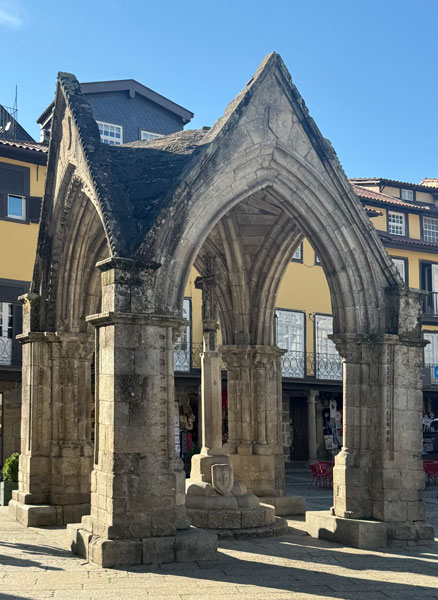
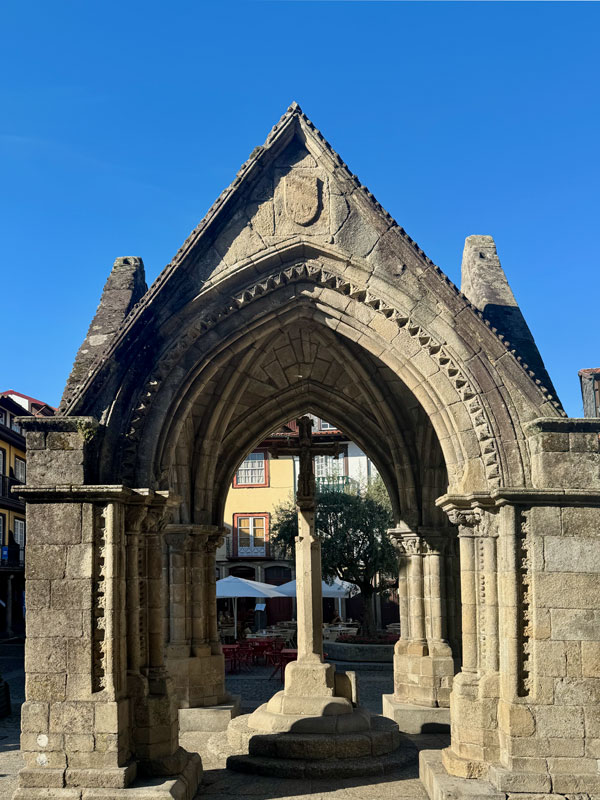
The name is derived from a centuries-old olive tree, once used to produce oil for a monastery’s lamps, that withered after being transplanted in the square. In 1342, the tree miraculously “regreened”, growing new leaves and producing fruit again after the arrival of a donated cross from a local merchant.
Because of this event, the square became known as Largo da Oliveira, and the nearby church was dedicated to Our Lady of the Olive Tree.
The cross stands at the center of a Gothic monument, the Padrão do Salads, through which the current olive tree is framed. This tree, the third, was planted in 1985.
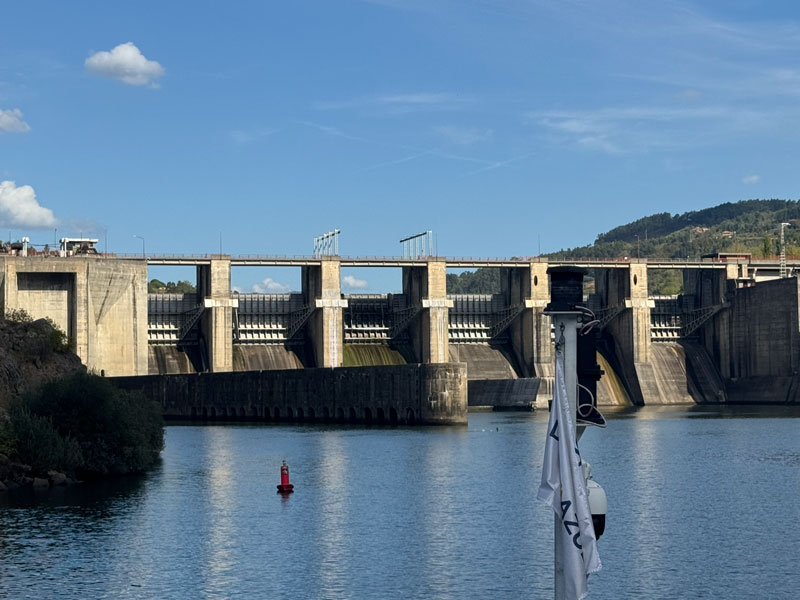
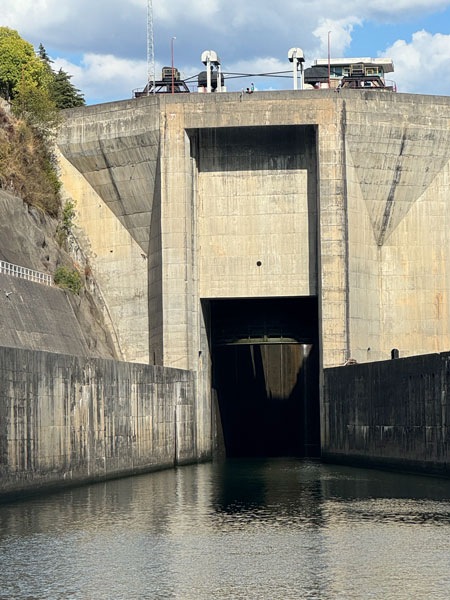
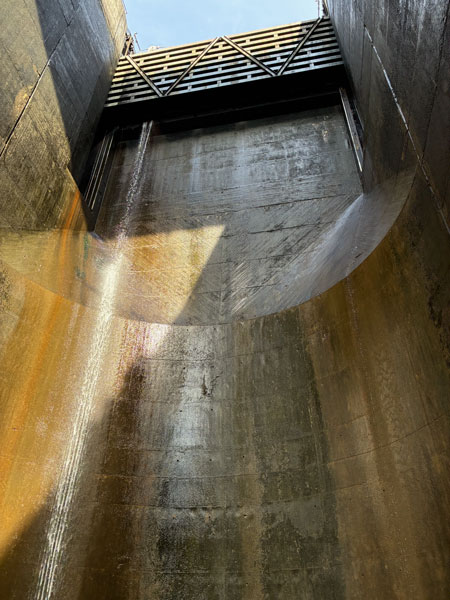
Between picking up the ship after visiting Guimarães and docking for the night in Regua, we had the opportunity to pass through one of the tallest navigation locks in Europe at the Carrapatelo hydroelectric dam. There was only one lock available for navigation here. (We had been informed that access was on a tight schedule and timing was everything.)
The lock chamber was interesting both for its size–smaller and narrower than many of the river locks we’ve experienced previously–and its rounded ends–tailored for the ship’s prow in either direction. Once we had entered the bespoke lock chamber, I better understood an earlier conversation on why Grand Circle leased rather than owned their cruise ships on the Douro. The ships are built specifically for this river.
We eventually reach our next port of call, Régua, which has little to offer in the way of tours or even walkabouts. The evening wraps with the usual port talk, dinner, onboard entertainment and room air conditioning challenge.
 Portugal: Lisbão to Oporto