
Tuk-Tuk tour of the town.
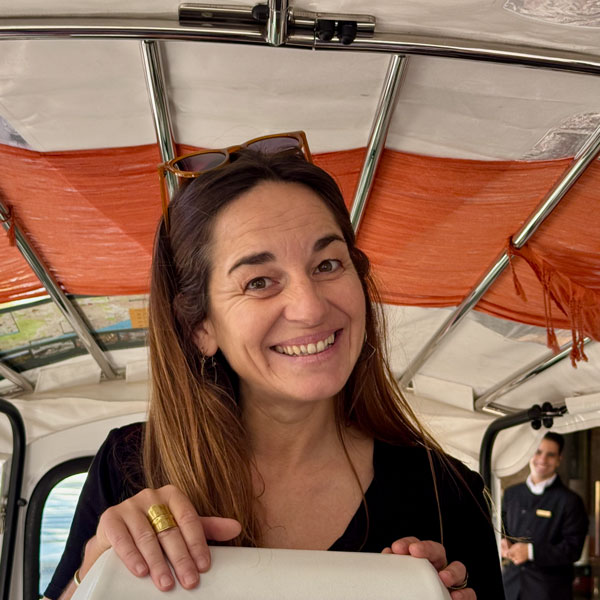
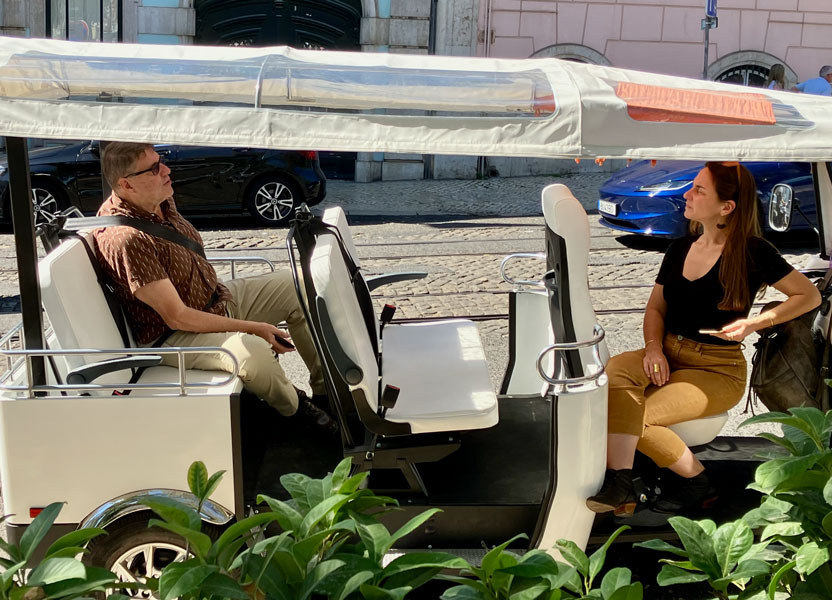
Today was our “planned” day with two, pre-purchased Lisbon excursions. The first was a 3-hour tuk-tuk tour concentrating on the old town (read: skipping Belém). These cute little 3-wheeled motorized rickshaw-hybrids have an amazing ability to climb and navigate the hilly, narrow streets of the city, getting us to locations our tired old bodies wouldn’t even think of attempting to reach. And we had an incredible driver-slash-tour guide in Katya, a perky and knowledgeable professional who spoke perfect English–as most Portuguese seem to–and rounded out her historic narration with charming and humorous anecdotes that verbally-moistened what could otherwise have been a dry, textbook narration.
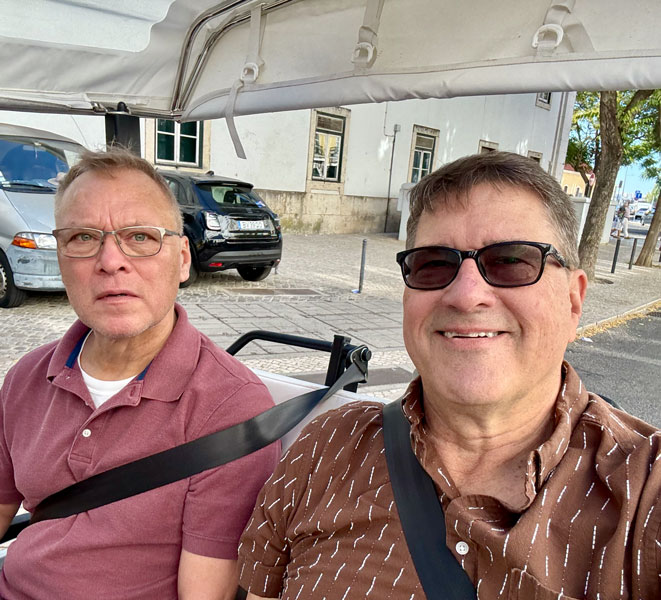
Katya, with Belém off the table, pivoted well from what was probably her standard tour script. We tasted (visually) the “new”, post-earthquake Lisbon rebuilt in the Parisienne-style that was so in vogue in 1755. Then, leaving the rigid rectangular grid of downtown, we entered the maze of twisting, ascending medieval streets that delineate the old city from the new. Being a Saturday, many streets were closed to traffic as weekend flea markets and abundant tourists took over.
Resourceful in the face of this human tsunami, Katya let three of our group off (I remained in the tuk-tuk) to wander through the ad hoc stands and tables until we rendezvoused in front of the National Pantheon.
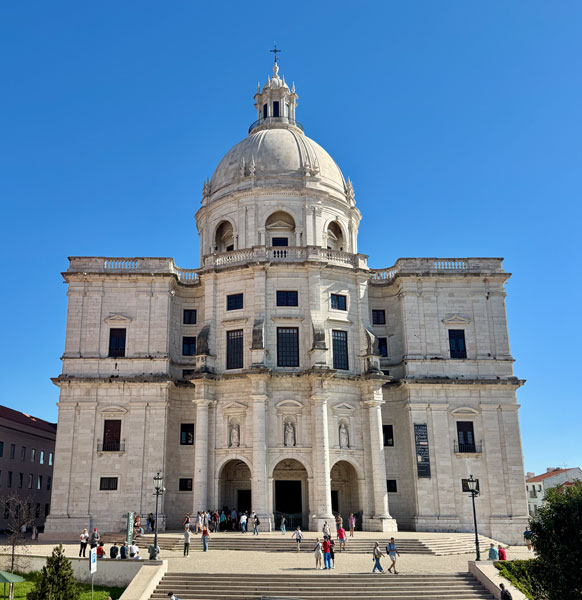
The National Pantheon
An imposing domed building originally started in the 17th c. as the Church of Santa Engrácia, the National Pantheon was completed in the 20th c. by the dictator’s regime to serve as the final resting place for notable Portuguese citizens. Salazar’s involvement initially tainted the project a bit in the peoples’ eyes, but it has since been accepted by the populace as the national monument it was intended to be.
Views From a Miradouro
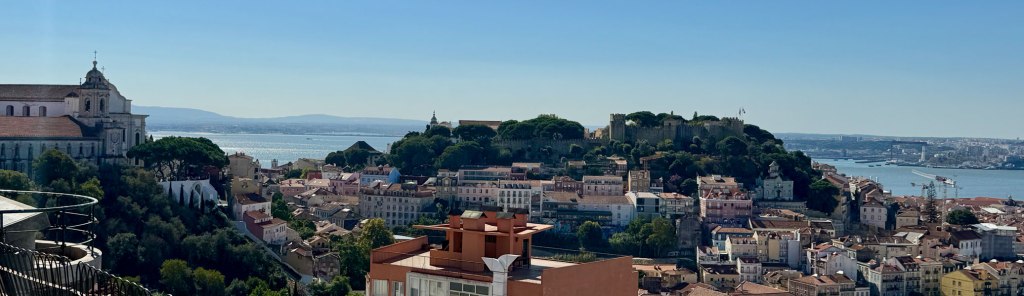
Lisbon, being built on seven hills, is known for its many scenic overlooks (or miradouros) that provide incredible panoramic views (and super photo ops) of the city.
So, after picking up Rob, Peg & Nancy in the front of the National Pantheon, Katya took (“tuk’d”) us up, up, up to the Miradouro de Nossa Senhora do Monte (Our Lady of the Mount viewpoint) where sun-washed Lisbon was spread out before us like an undulating red-tile patchwork carpet. Crowded as the viewpoint was, it was relatively easy to get railing-side once the phone-wielding influencers and tourists finished posing and posting. (Sarcasm aside, most everyone was very polite.)
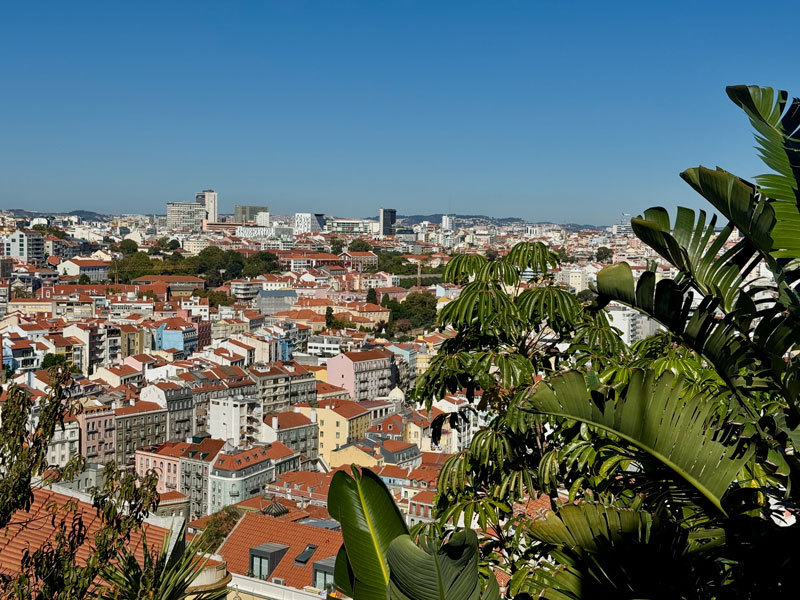
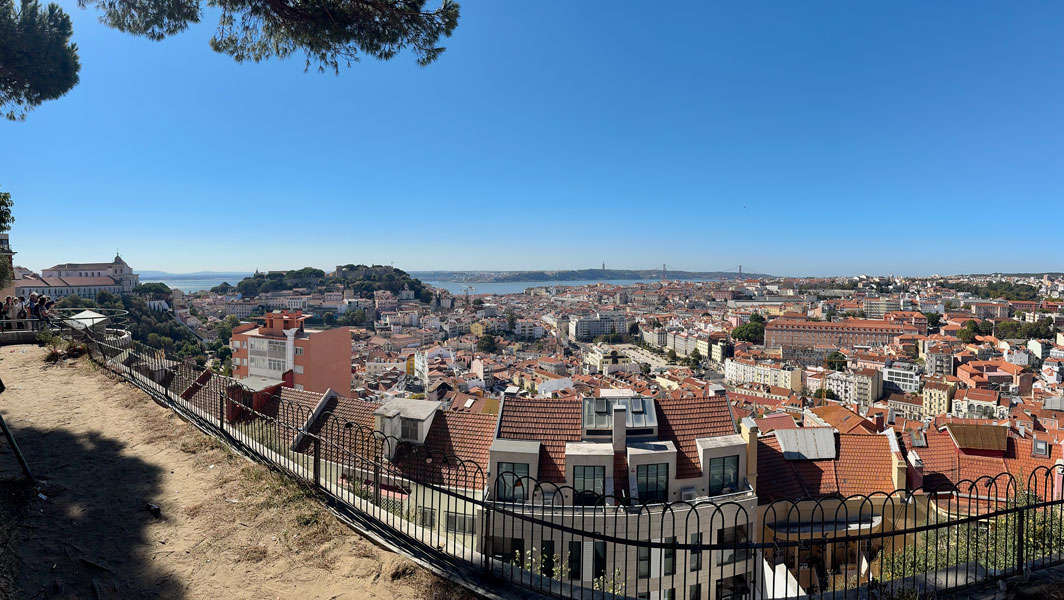
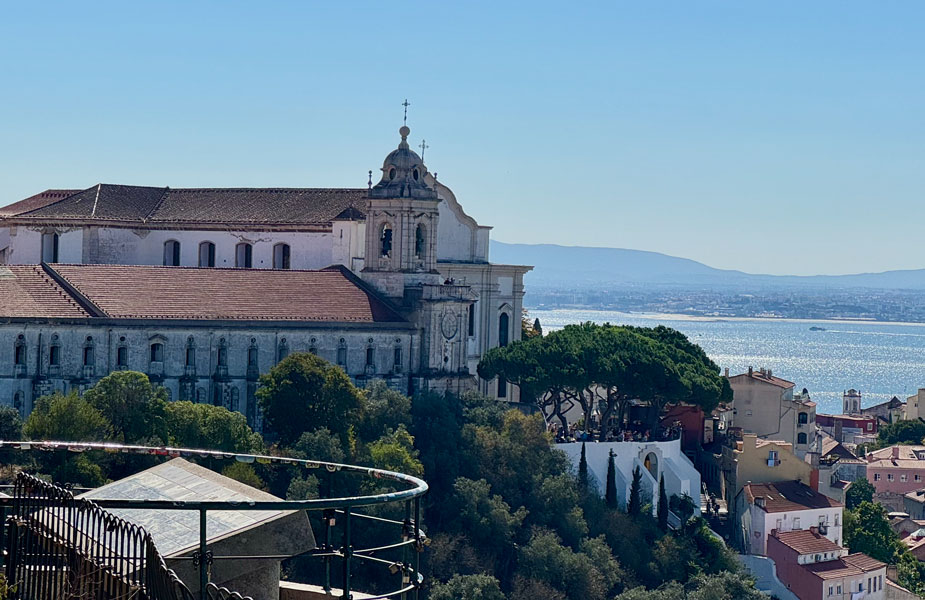
Stopping there also afforded us a chance to use the facilities…altho’, as it turns out, we actually couldn’t “afford” to do so as none of us had enough euros to access the loos. (Yes, you pay to pee. Shades of Urinetown!) Fortunately, Katya and her change purse came to our rescue.
Miradouro Selfies (We were there!)
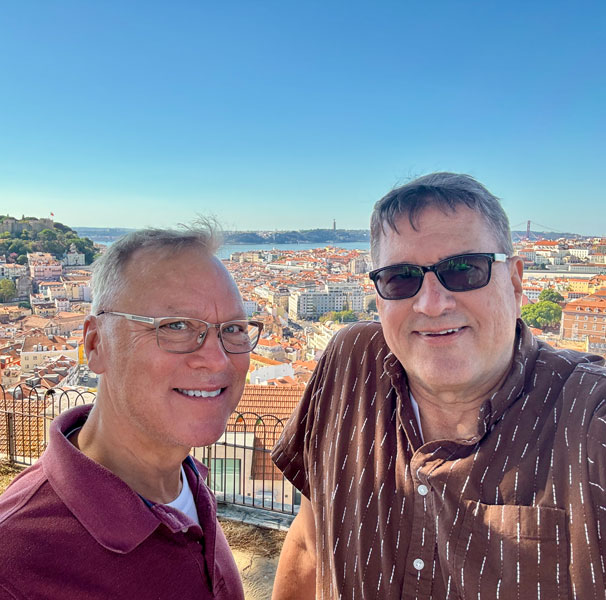
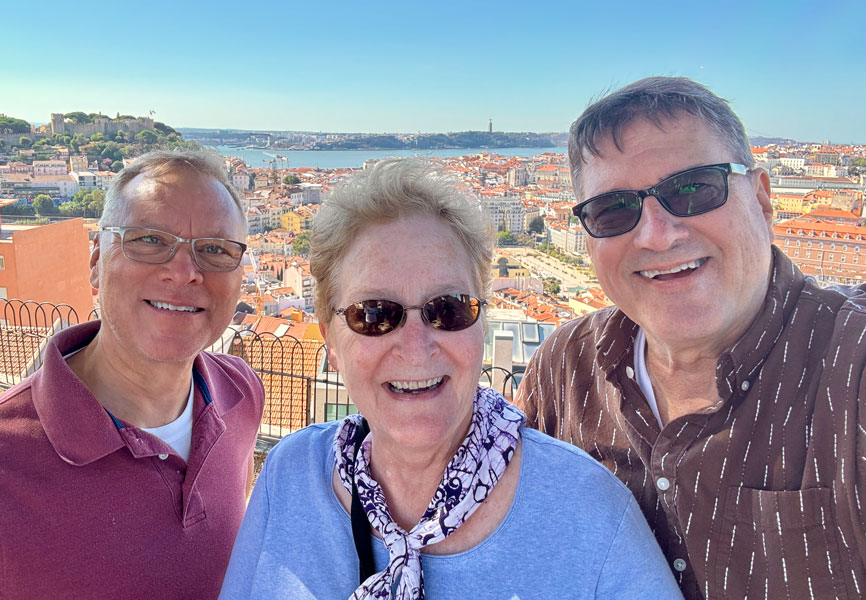
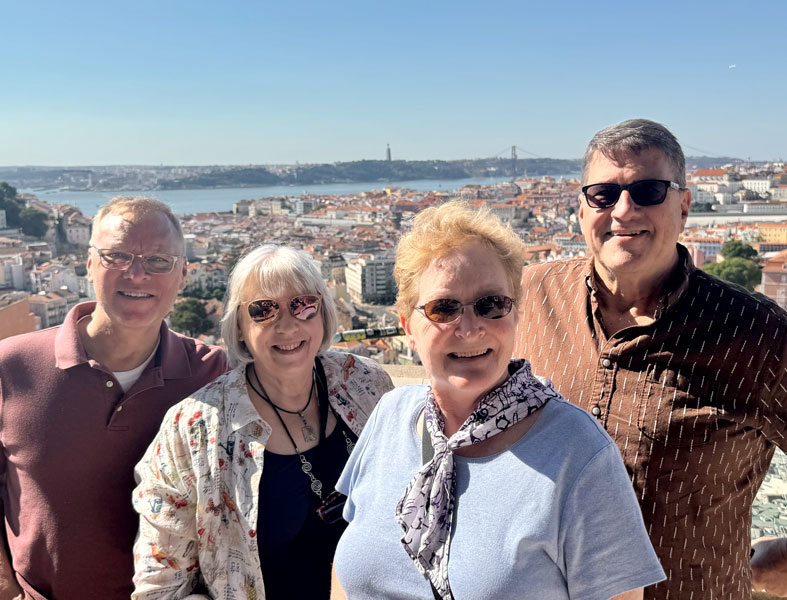
After sufficient pictures–scenics and selfies–were taken and our bodily needs were addressed, we piled back into the tuk-tuk for our descent to the Lisbon riverfront. Our time with Katya was coming to an end and her final task was to get us to the National Tile Museum by 1:00 PM. This would give us enough time for lunch before our ticketed 2:00 PM entry time.
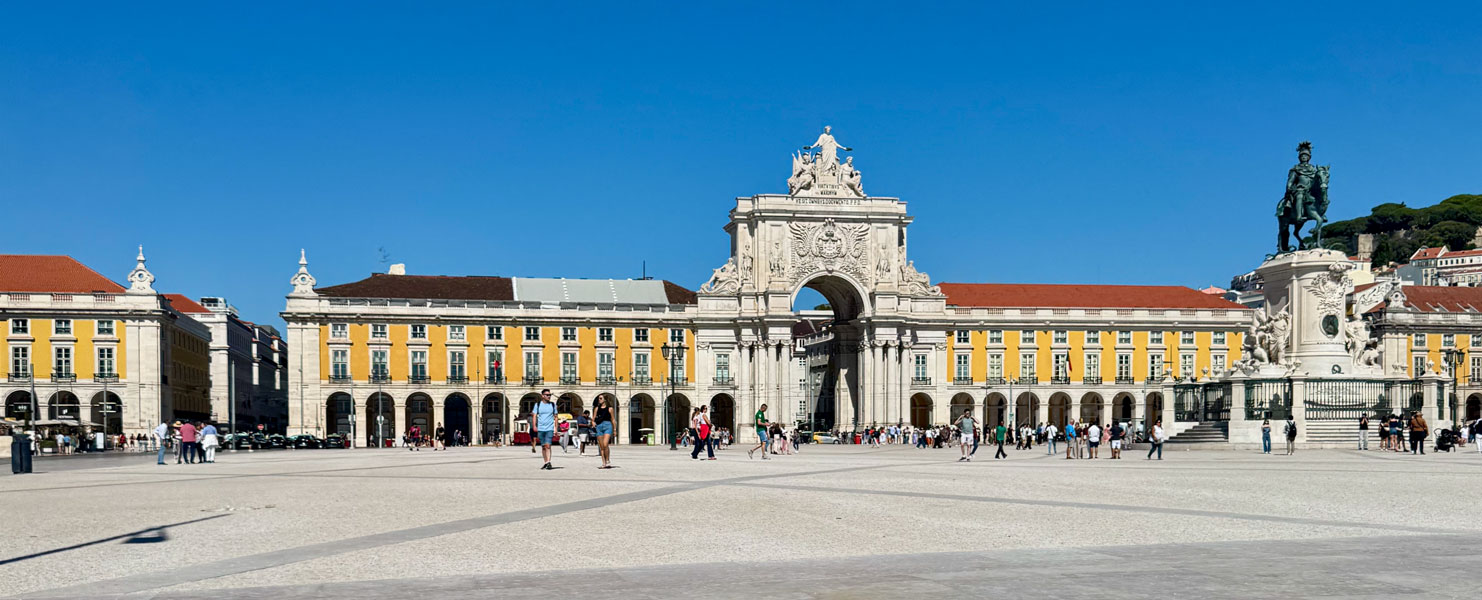
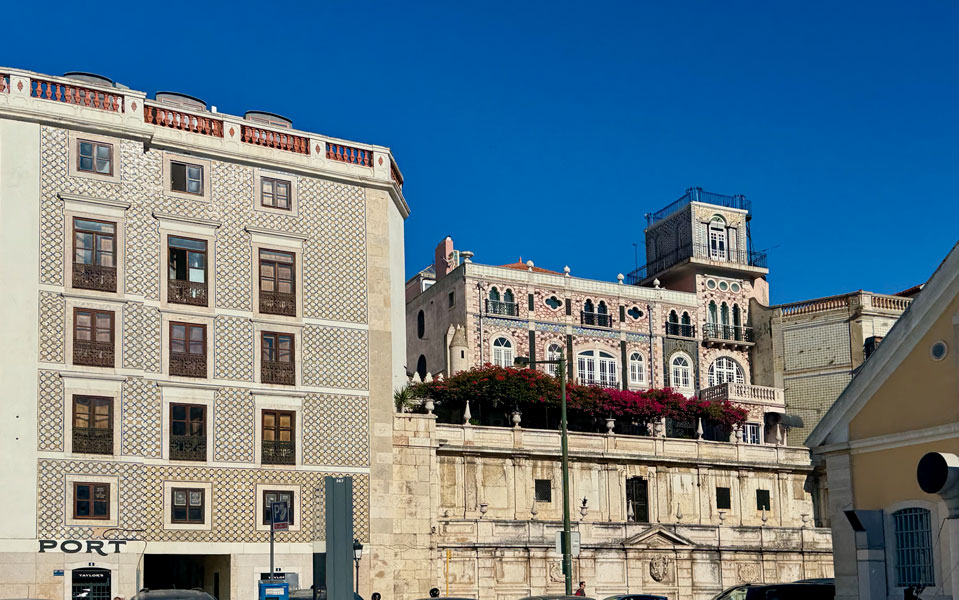
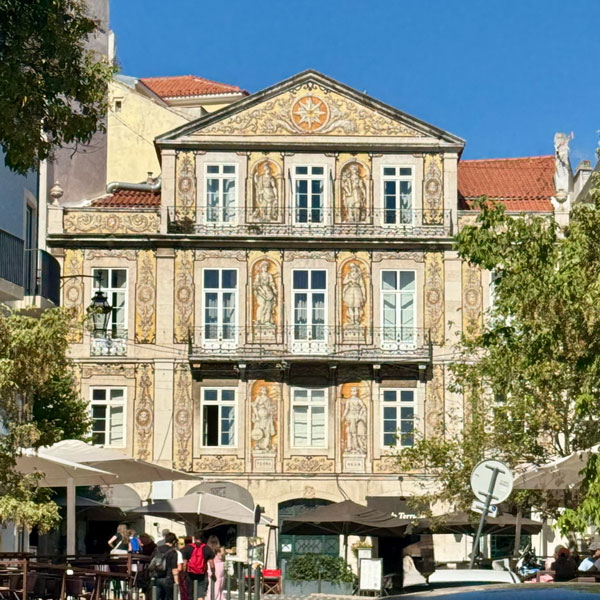
Our route took us away from central Lisbon along the Tagus River. We passed the great harbor-facing plaza, the Praça do Comércio, constructed as Lisbon’s commercial heart when rebuilding commenced after the 1755 earthquake. Once past the plaza, we lost sight of the river from the right-hand side. Several large cruise ships were docked at the riverfront terminal; then railroad tracks and industrial structures blocked our view. However, to the left, numerous buildings, often tile-covered, artistically painted or otherwise architecturally-interesting, drew one’s eye upward from the level shoreline into Lisbon’s oldest neighborhood, the Alfama, above.
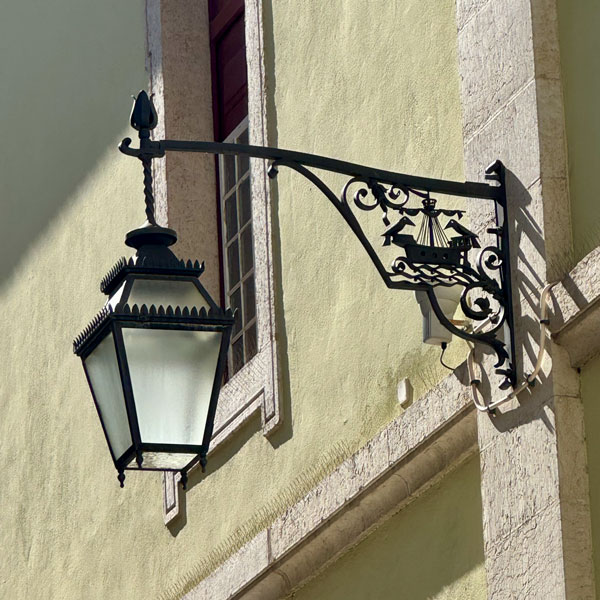
Among the legendry that is woven into the very soul of Lisbon is the saga of St. Vincent, the patron saint of the city. It is said that, after his martyrdom in 1173, ravens kept guard over his bodily remains. When his relics were being transported to Lisbon, ravens continued to watch over them on the ship. This image of a ship with ravens perched on the bow and stern became a symbol of Lisbon and is incorporated into the city’s flag, its coat of arms…and elsewhere, as seen on the streetlight’s wall bracket.
Museu Nacional do Azulejo (National Tile Museum)
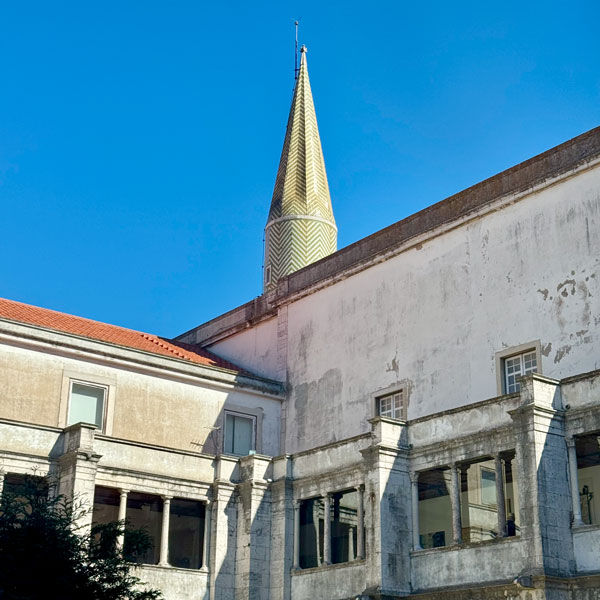
Katya was as good as her word and deposited us at the museum’s entrance at 1:00 PM. Once here, we discovered that, contrary to their website, the museum did not close for an hour between 1:00 and 2:00; we could have gone right in, damn the entry time.
<- Note the tile-covered steeple atop the building
However, our tum-tums were a-grumblin’ so we each purchased some food and drink at the museum’s cafeteria counter and ate in the adjacent garden courtyard. Once sated, we ventured into the former convent-turned-museum.
Tiles…tiles…and more tiles
Well, one could never mistake this place for anything other than a museum dedicated to tile. If there was wall space, there was tile. Most of the explanatory signs were, of course, in Portuguese with the occasional bit of English. But, for a non-native speaker (despite my months at Duolingo), it was mostly just a visual experience colored by one’s emotional response–which explains many of my photo choices. Below is a collage of tile examples I found personally interesting…or strange…or amusing. Or all three! I’ll let you be the judge.
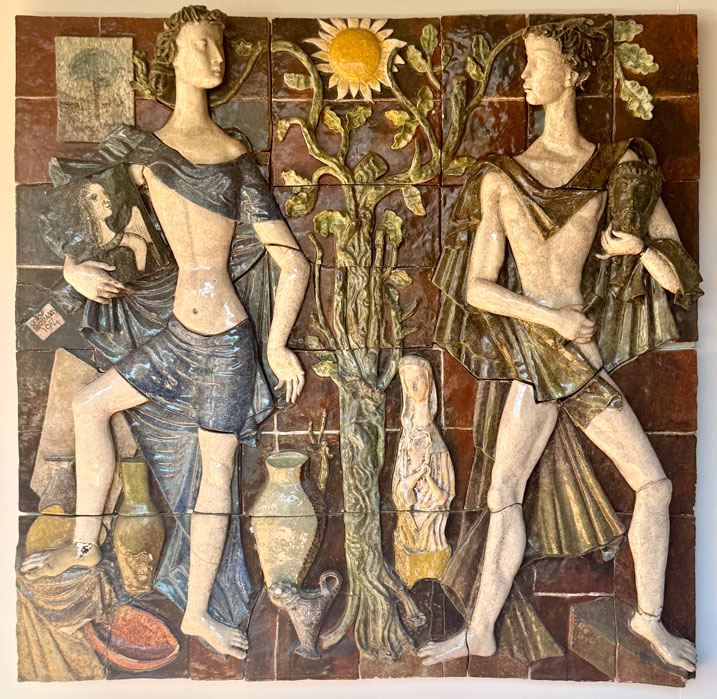
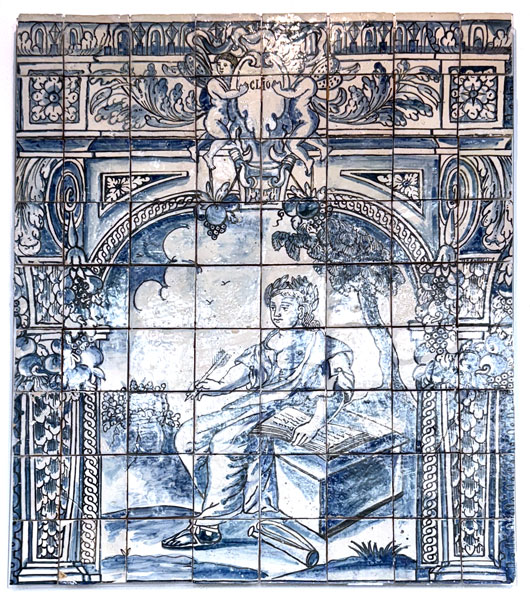
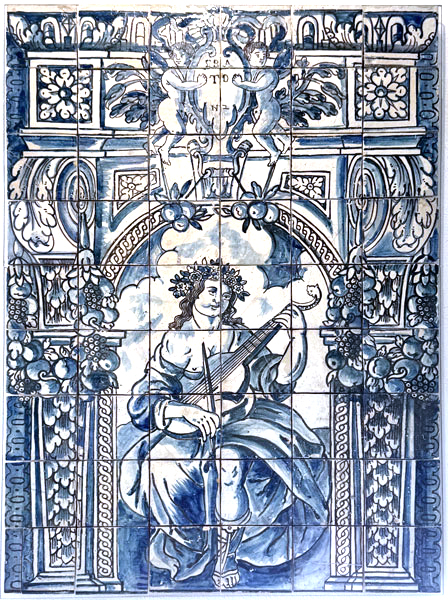
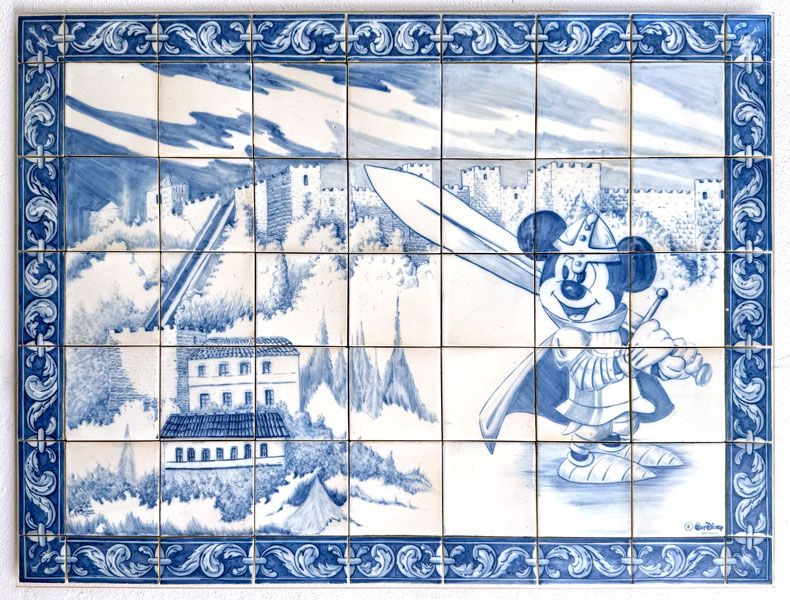
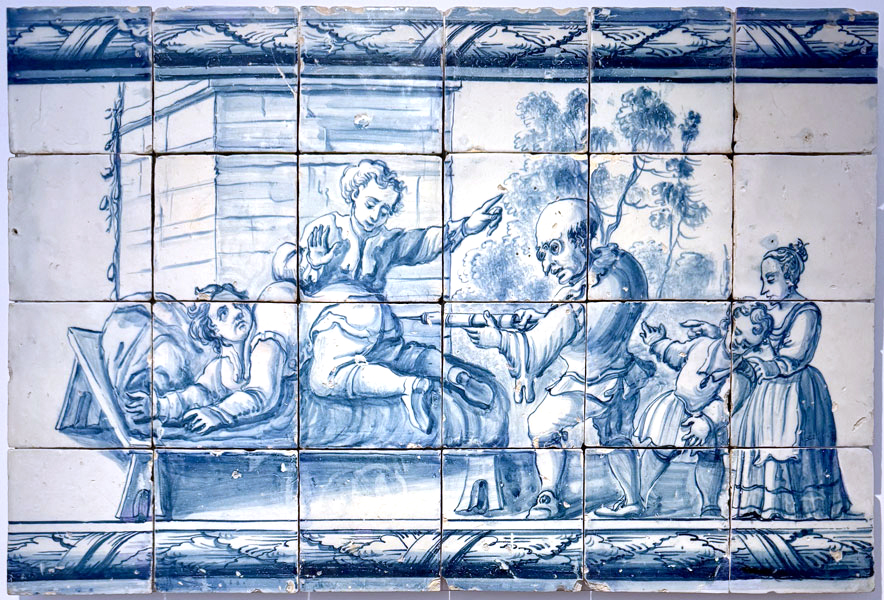
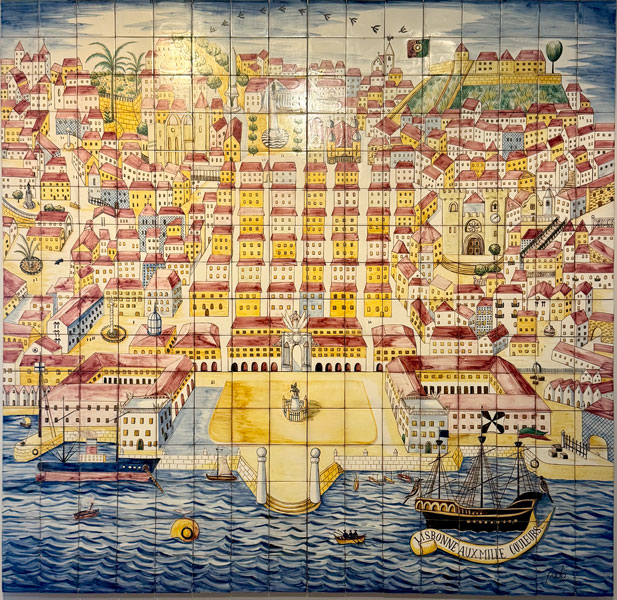
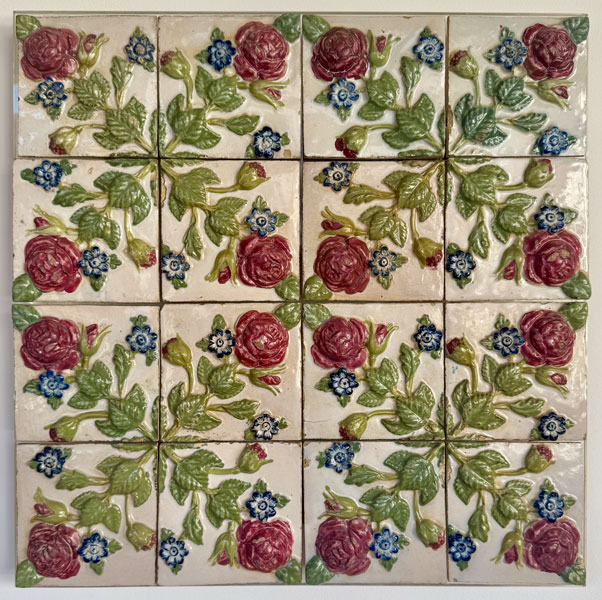
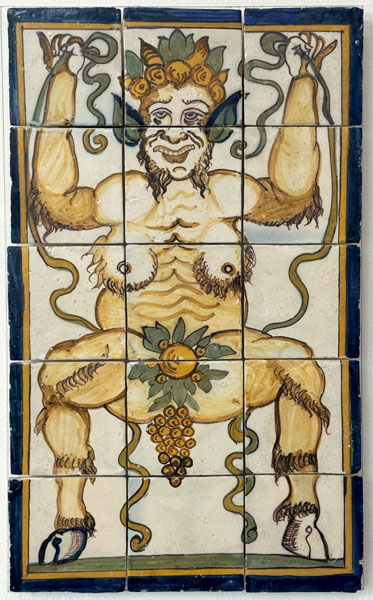
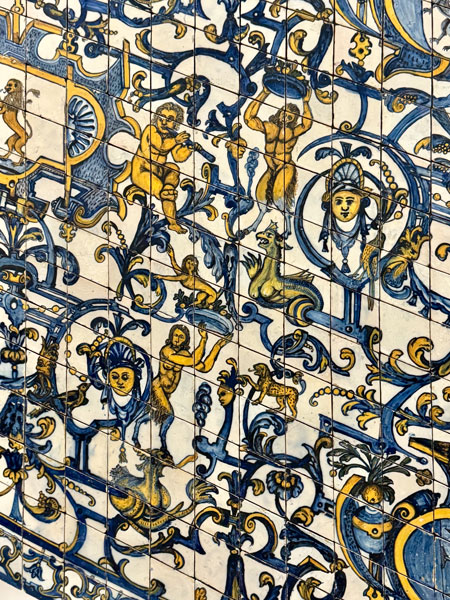
• The 3D tile work fascinating. The one featuring two anorexic dudes was labelled “Allegory of Painting and Sculpture.” Later investigation (read: googling) revealed that the artist played a significant role in revitalizing the field of artistic tile work in Portugal.
• The two Muses, Clio (of history) and Erato (of lyric & erotic poetry), frequently pop up in crossword puzzles…especially the latter. Hence, their inclusion here.
• Finding Mickey Mouse depicted in tile was amusing. But finding a bald, bespectacled doctor wielding a medieval butt-probe to the obvious dismay of his patient was downright hysterical. A must-capture!
• Emotionally, I found the rose-patterned tiles singularly beautiful. Imagine my surprise later when I came across whole facades of three-dimensional tile on actual buildings in Lisbon and Porto.
• And then there was Silenus. A Greek mythological figure, he is the chief of the satyrs. But this rustic, wine-loving, jovial drunkard is best known as the loyal companion, tutor and foster father of the god Dionysus. His story aside, I was fascinated more by his Vulcan ears, hairy mammaries, sun-flower’d crotch and bunch-o’-grapes excrement. (I know. I’m just a very large 13-year old boy.)
Enough of that, you might say. But no.
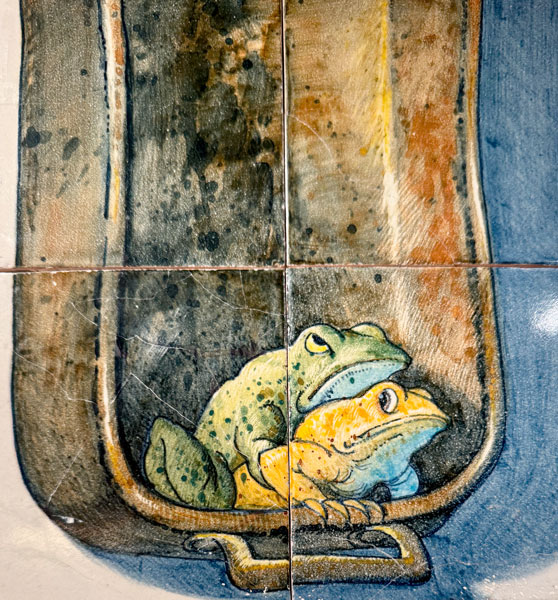
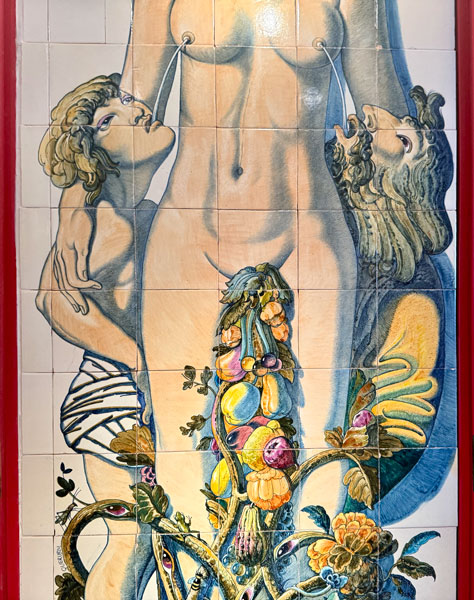
Going up one floor, we found a very special installation of a reconstructed kitchen. The exhibit featured an artist’s commissioned tile work that had been removed from the original kitchen of a real house somewhere in Portugal and was reassembled here.
I will let your own imagination run wild with these “curated” images. Then try to imagine every wall of an entire room featuring similarly demented representations of food, food sources and food preparation.
Bon appetite.
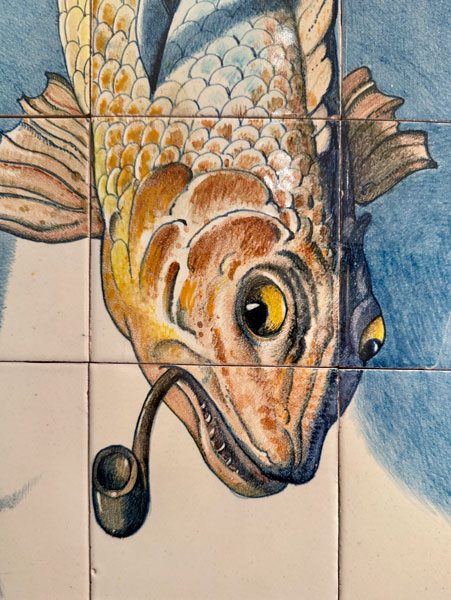
After all that ceramic, we took an Uber back to the hotel to meet up with our Program Director, enjoy a welcome drink with the rest of our Yellow group, and join the orientation walk around the hotel vicinity…until we didn’t.
We’d been cued in on a nearby restaurant for dinner: ChuChu’s. It turned out that the orientation walk passed within two blocks of its location. Since it was 7:00 PM on a Saturday night and we had no reservations, we felt that it behooved us to break off from the pack and try to secure a table now rather than later. So, bidding Joana and the gang farewell, we hightailed it to Chu-Chu’s and were rewarded with a sidewalk table for four.
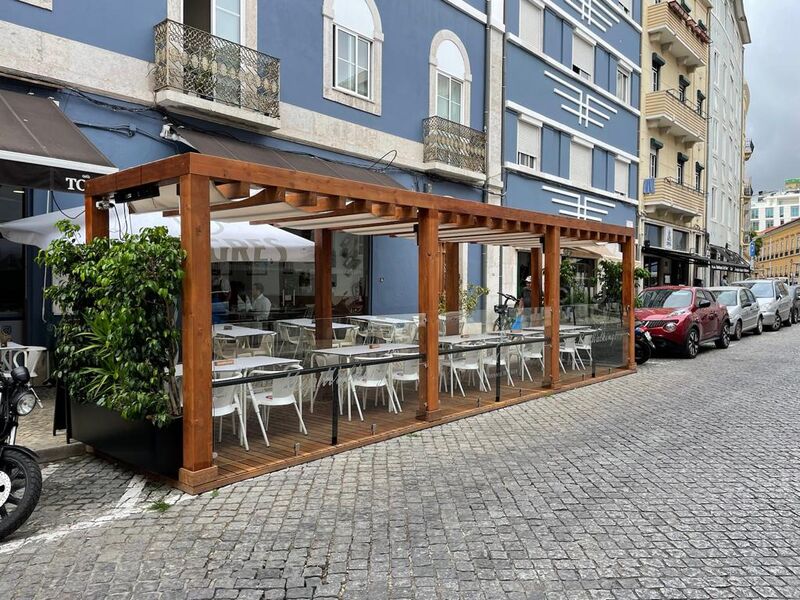
Dinner was delicious. Everyone was served much more food than they expected–my half-chicken portion almost seemed to be a whole bird–and we left fully satisfied.
Happy “Cast Iron” Anniversary to Mom & Dad. It woulda been 73 years.
 Portugal: Lisbão to Oporto